


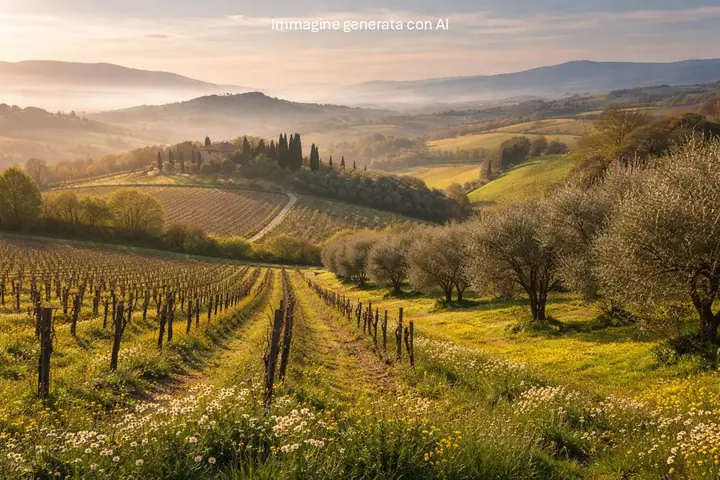
Across vineyards, olive groves and cellars: the month when everything begins to take direction
March, particularly towards the end of the month and into early April, is when the agricultural world truly begins to shift gears. Spring has not yet fully arrived, but winter is already behind us: it is a period of active transition, when everything prepared over the previous months begins to become visible.
Across the regions where Ufarmer’s producers are based — from the Tuscan hills to Mount Etna, from the Langhe to the Colli Orientali del Friuli, and on to the volcanic soils of Veneto — nature begins to stir. Not with a sudden burst, but through gradual, steady, and harmonious growth.
In the vineyards, pruning is now complete, giving way to careful observation of budbreak. The first buds begin to emerge, already revealing a great deal about the vines: their uniformity, balance, and response to the growing conditions. Attention shifts to soil management, moisture control, and the details that allow the vines to begin the new growing cycle without stress. In more extreme areas, such as Mount Etna, work also continues on terraces and dry-stone walls, while in the hills, growers closely observe the soil to understand how it will support the vines throughout the season.
In the olive groves, work enters a particularly active phase. Pruning begins or continues, with the aim of rebalancing the canopy and improving sunlight exposure and airflow. Cover crops, now actively growing, take centre stage: they protect and nourish the soil while improving its structure. This is the moment when the soil ceases to be merely a support and once again becomes a living part of the production process.
At the olive mill, the new oil has now reached a stable balance. Its aromas become more defined, the balance between bitterness and pungency becomes more harmonious, and its structure gains greater coherence. This is the moment when the oil fully expresses its identity, shaped by the journey from harvest to processing.
In the cellar, the work remains quiet, but its intensity begins to shift. The wines start to reveal what they will become: more integrated, more expressive, and more harmonious. The tannins become more refined, the aromas begin to fall into place, and the structure gradually opens up. It is not yet time for final decisions, but this is when the direction of each wine becomes clear.
Each region experiences this phase in its own way. On Mount Etna, snow and warm lava still coexist; in Friuli, the Bora wind dries and shapes the hillsides; in Tuscany, the Tramontana wind supports balanced growth; while in the Langhe, longer daylight makes the landscape appear sharper and more defined. This diversity is reflected in the wines and oils, yet they all share a common thread: precision.
Late March and early April may not be spectacular, but they are essential.
It is the time when everything begins to take shape.
What was an intention in February now becomes a clear direction.
And from this point on, there is no turning back.