


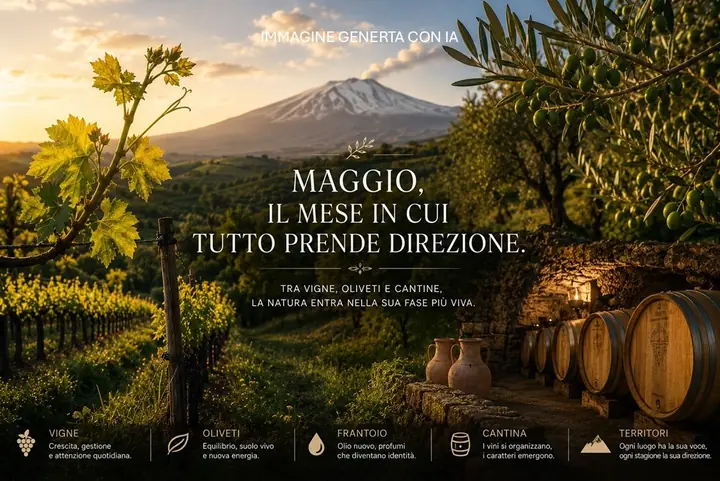
May is the month when the countryside finally stops preparing and truly springs into action.
Across the regions where Ufarmer’s producers are based — from the lava terraces of Mount Etna to the Tuscan hills, from the Langhe to the Colli Orientali del Friuli, and on to the windswept vineyards of Abruzzo and the volcanic soils of Veneto — nature enters its most vibrant phase. Growth is no longer a promise: it becomes a tangible, daily presence, visible in every vineyard row and every olive grove.
The days grow longer quickly, the light becomes more intense, and the landscape gains depth. The air often remains cool in the morning, but the sun begins to warm the soils, stones, clay, and lava surfaces more consistently. It is a month of energy, but also of balance: everything grows rapidly, and for this very reason every intervention must be carefully timed and precise.
In the vineyards, budbreak gives way to canopy management. The shoots grow longer and are carefully positioned by hand along the wires, while maintaining good airflow within the canopy becomes essential. This is the time when vineyard work becomes continuous, almost a daily task. Each region responds in its own way: on Mount Etna, altitude slows and differentiates growth; in the Colli Orientali del Friuli, the Bora wind helps keep the vineyards dry; in Tuscany, cover crops support soil management; while in the Langhe, the longer hours of daylight already begin to shape the character of the season.
In the olive groves, May also brings a profound change in the pace of work. The olive trees enter a period of vigorous vegetative growth, and soil management becomes a key priority. Cover crops are carefully managed to maintain the right balance between vitality, moisture, and airflow. The focus is not only on the trees themselves, but on the entire agricultural ecosystem. This is the time of year when the soil truly reveals the quality of the work carried out during the winter and early spring.
At the olive mill, the new oil continues its gradual settling process. Its aromas become more defined, bitterness and pungency integrate more harmoniously, and the finish becomes longer and more elegant. The oil’s identity is now clearly established: no longer fragmented into individual components, but cohesive and harmonious.
In the cellar, May is a particularly important month, as many wines truly begin to evolve. Their structure becomes more relaxed, the tannins more defined, the aromatic notes become better integrated, and the finish gains greater continuity. The wines do not lose their energy; rather, that energy begins to find its balance. This is the moment when the work carried out over the previous months finally becomes evident in the glass.
Each region retains its own distinctive voice. On Mount Etna, lava, wind, and altitude continue to shape wines with tension and minerality. In Friuli, ponca soils contribute to increasingly precise, vibrant white wines with a distinctive sense of freshness. In Tuscany, the interplay between soil, cover crops, and ventilation builds balance and depth. In the Langhe, growth remains steady and gradual, while in areas closer to the sea, sunlight and sea breezes already begin to bring the Mediterranean character that will later emerge in the wines of summer.
May is not yet the month of maturity.
It is the month when the season finds its definitive direction.
What was planned in winter and observed in spring now truly begins to take shape.
And this is precisely when the agricultural season begins to reveal its true character.