


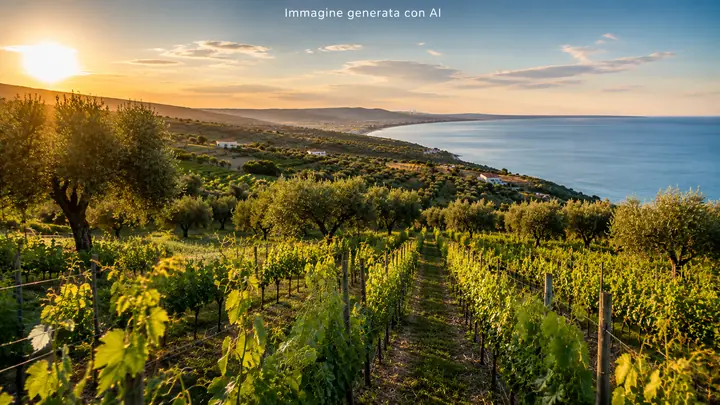
June is the month when the agricultural season begins to reveal its promise.
Across the regions where Ufarmer’s producers are based — from the slopes of Mount Etna to the Tuscan hills, from the Colli Orientali del Friuli to the Langhe, from vineyards overlooking the Adriatic to the olive groves of Tuscany and Southern Italy — the growing season enters a crucial phase. Ripening has not yet begun, but this is the moment when the potential of the vintage starts to reveal itself.
The days reach their longest point, sunlight becomes a constant presence, and the landscape undergoes a profound transformation. Vineyards display neat rows and fully developed canopies, while the first tangible signs of the future harvest begin to appear in the olive groves. Growth remains vigorous, but compared with May, the focus of the work gradually shifts from supporting vegetative development to monitoring the plants’ overall balance.
In the vineyards, June coincides with fruit set, one of the most important stages of the entire growing cycle. After flowering, the small berries begin to form and the grape clusters take on their final structure. It is a delicate phase, as this is when the quantity, uniformity, and quality potential of the future harvest begin to emerge.
For the winegrower, June is above all a month of observation. Canopy management continues through targeted interventions designed to improve airflow, sunlight exposure, and humidity control. Across Italy’s major wine-growing regions, each area retains its distinctive identity: on Mount Etna, differences between altitudes and individual contrade become increasingly evident; in the Langhe, Nebbiolo slowly develops its balance; in Friuli, the ponca soils support steady, even growth; while in Tuscany and Abruzzo, sunlight and ventilation help maintain harmony between vegetative vigour and fruit development.
In the olive groves, June is an equally important time. After flowering comes fruit set, the stage when the olives begin to develop. This phase requires constant attention to water balance, soil management, and the overall vitality of the agricultural ecosystem. The olive trees already show the first signs of the autumn crop, making the results of the work carried out over the previous months increasingly visible.
In the cellar, the wines continue their ageing journey at an unhurried pace. Their different components begin to come together more naturally: the fruit becomes better integrated with the structure, the tannins grow more harmonious, freshness finds its balance, and the various aromatic nuances begin to move in the same direction. The wines have not yet reached their fullest expression, but this is the month when the consistency of their style begins to emerge more clearly.
Oils also continue their natural settling process. Their herbaceous notes become more precise, bitterness and pungency gradually integrate, and the oil’s distinctive character becomes increasingly well-defined and recognisable.
Each region tells the story of this stage in its own way. On Mount Etna, the promise of the new vintage is shaped by the interplay of lava, altitude, and sunlight. In the Colli Orientali del Friuli, ponca soils guide the vine’s natural balance. In Tuscany, careful soil management and biodiversity foster harmony and continuity. In the Langhe, precision in the vineyard accompanies the development of the grape clusters, while in areas closer to the sea, constant ventilation continues to shape the character of both wines and oils.
June is not yet the month when the final results are revealed.
It is the month of promise.
The moment when nature stops merely hinting at possibilities and finally begins to reveal them.
This is where the future of the season begins to take shape.