


In spring the olive tree decides its harvest. Between late February and March it wakes up from its winter rest. Between March and April the flower clusters appear: small bunches of buds that Italian growers call mignole. Between May and the first half of June comes the actual flowering, followed straight away by fruit set, the moment when the fertilised flowers turn into tiny olives. The dates shift with the variety and the latitude: in Sicily olive trees flower earlier than around Lake Garda. The mechanism, though, is always the same, and it is what decides how much oil will reach the mill in autumn. Here you will find each stage, what the olive grower does at every step and what is worth knowing if you follow an olive tree from afar.
Adopt an olive tree
Follow your olive tree through spring
With UFarmer you adopt an olive tree from a small Italian producer, get updates throughout the season and, once the harvest is over, receive your extra virgin olive oil.
In short
- Awakening: growth restarts between late February and March, as the days get longer and temperatures rise.
- Flowering: in Italy it usually falls between late April and June, depending on the cultivar and the area. Each flower cluster stays in bloom for about 7-10 days, but across the tree flowering happens in waves.
- Pollination: it relies on the wind. Heat above 30-35 °C, dry wind or persistent fog can spoil an abundant bloom.
- Fruit set: on average only 1-2% of the flowers become an olive. Seeing lots of flowers drop is normal.
- The link with the oil: this year’s flowers grow on last year’s shoots, and the new oil that arrives in autumn is born in these months.
Contents
- The olive tree’s spring calendar
- From winter dormancy to awakening
- Flower clusters: how the flowers form
- When do olive trees flower?
- Pollination: the wind does almost everything
- Fruit set: why almost all the flowers fall
- What the olive grower does in spring
- From spring to new oil
- Our view: spring is the best chapter to tell
- Adopt an olive tree and follow its spring
- Frequently asked questions
- Sources
The olive tree’s spring calendar
Before the details, here is the sequence at a glance. The periods are indicative and refer to central Italy. In the South everything comes a few weeks earlier, in the North and in the hills a little later.
| Stage | Indicative period | What you see on the tree | What matters |
|---|---|---|---|
| Winter dormancy | December-February | Canopy at rest, no new shoots | Cold, pruning at the end of winter |
| Growth restarts | late February-March | Swelling buds, paler shoot tips | Light, mild temperatures, nitrogen |
| Flower clusters | March-April | Green bunches of buds where the leaves meet the stem | Available water and nutrients |
| Flowering | late April-June | Tiny white flowers, pollen in the air | The right wind, no extreme heat |
| Fruit set | late May-mid June | Falling petals, swelling ovaries | Water, boron, no stress |
This is the sequence described by the Oliva Ascolana del Piceno Consortium in its table of growth stages (in Italian), which places winter dormancy between December and February, and by the agronomists who follow the cycle in the field.
From winter dormancy to awakening
The olive is an evergreen and never stops completely. As the botanical profile by the Mediterranean Natural History Museum in Livorno (in Italian) explains, its growth is almost continuous and only slows down in winter. So dormancy is a pause rather than a deep sleep: the tree keeps its leaves, breathes slowly and waits.
It wakes up when the hours of daylight increase and temperatures stay mild. In practice that means between late February and March in most Italian olive groves. The first signs are subtle: the buds at the tips of the branches swell and the tips of the shoots turn a lighter, almost silvery green.
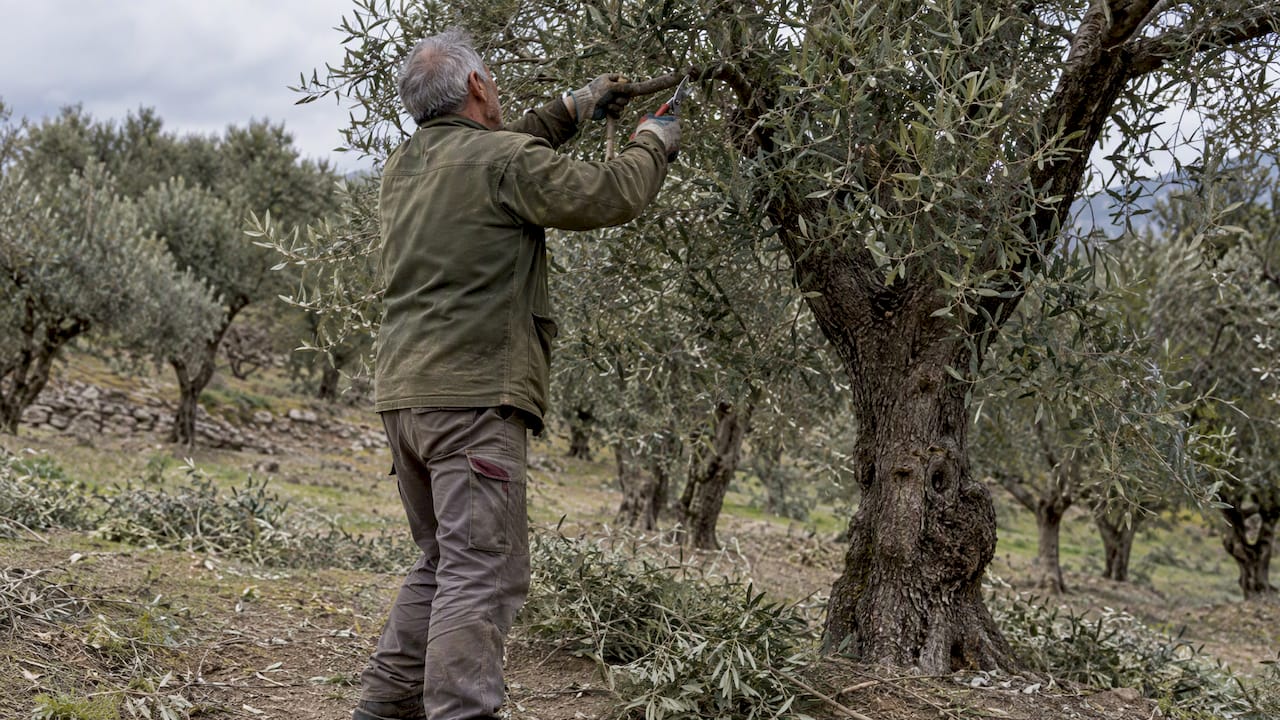
Pruning at the end of winter
People who look up “pruning olive trees in winter” usually want to know whether you can prune in the cold. Experienced growers prefer the end of winter, when the risk of hard frosts has passed but the tree has not yet fully restarted. Pruning during a frost exposes the cuts to the cold. Pruning too late, when the shoots are already growing, takes away energy the tree needs to flower.
Pruning does three things: it lets light and air into the canopy, removes old or diseased wood and keeps a balance between fruiting branches and growing branches. An open canopy also helps pollination in May, because the wind moves through it more easily.
Flower clusters: how the flowers form
In spring something happens that surprises anyone looking at an olive tree for the first time: the flowers do not appear on the new branches. As Teatro Naturale explains in its analysis of the flowering stages (in Italian), the olive’s biological cycle takes two years: the flower forms on shoots that grew the year before, about 15 months before flowering.
This explains a lot. A dry summer or a very late harvest the year before can weaken the shoots that will carry the flowers. So the harvest is partly written before the tree even flowers. It is one of the reasons behind alternate bearing, the “on” years followed by “off” years, a point also stressed by the Riviera Ligure PDO Olive Oil Consortium (in Italian).
Between March and April the flower clusters appear where the leaves meet the stem: small bunches of green buds, still closed. Each cluster will carry anywhere from about ten to a few dozen flowers. The more clusters you see, the more the tree “promises”. But it is only a promise, because the hard part comes later.
When do olive trees flower?
The short answer: between late April and June. According to Teatro Naturale, flowering runs from April to June (in Italian), depending on the variety and the latitude. For Frantoi On Line, flowering falls between May and June (in Italian), depending on the climate zone and the cultivar.
In practice, in Italy you will usually see:
- The South and the islands (Puglia, Calabria, Sicily, Sardinia): flowering can start as early as late April and peaks in May.
- Central Italy (Tuscany, Umbria, Lazio, Marche): mostly in the second half of May.
- The North and hill or lake areas (Liguria, Lake Garda, the hills of Emilia and Veneto): between late May and the first half of June.
These are trends, not rules. A warm spring brings everything forward by one or two weeks, a cold and rainy one holds it back.
The stages of flowering
Olive flowering is not a one-day event. You can tell a few moments apart:
- Closed flower buds: the clusters lengthen and the buds turn from green to creamy white.
- Start of flowering: the first flowers open, tiny, with four white petals.
- Full bloom: at least half of the flowers are open and the pollen is released into the air. This is the decisive moment for pollination.
- End of flowering: the petals turn brown and fall, often leaving a white veil under the canopy.
Each flower cluster stays in bloom for about 7-10 days, but the tree flowers in waves. As Frantoi On Line (in Italian) notes, the south-facing parts of the canopy flower first. On the same tree you can find branches in full bloom and branches still in bud. That is why crop protection treatments, for example against the olive moth, have to follow this gradient instead of being applied to the whole grove on the same day.
Pollination: the wind does almost everything
The olive tree does not need bees. Pollination is carried by the wind: pollen travels from flower to flower and from tree to tree. This is why the layout and the varieties in the grove matter a lot. Many Italian cultivars are partly self-sterile and produce better when trees of another variety grow nearby and act as pollinators.
The weak spot is the weather. As Teatro Naturale (in Italian) explains, sudden temperature swings with peaks of 30-35 °C, dry wind or persistent fog during flowering can stop the pollen from germinating. The result is the olive grower’s most typical disappointment: a splendid bloom and few olives. Heavy rain on the days of full bloom also does damage, because it washes the pollen away and weighs the flowers down.
If you love olive oil, it is a good reason to read the May weather news with different eyes. A week of scirocco, the hot wind from the south, at the wrong moment in Puglia or Tuscany is felt months later in the price and availability of that year’s extra virgin olive oil.
Fruit set: why almost all the flowers fall
Fruit set is the step from flower to fruit: the fertilised ovary starts to swell and becomes a tiny green olive, the size of a pinhead. It happens right after flowering, usually in the first half of June.
The figure that surprises everyone is this: on average only 1-2% of the flowers actually turn into fruit. The Riviera Ligure PDO Olive Oil Consortium (in Italian) points this out and warns not to mistake falling flowers for a lost harvest. The tree produces a huge surplus of flowers precisely to make up for uncertain weather and the low success rate. A mature tree can open hundreds of thousands of flowers: even with a very low fruit set, enough remain for a good harvest.
After fruit set comes a second natural thinning, the drop of the young fruit. The tree sheds part of the newly formed olives to keep only those it can feed. This is also normal, within limits. It becomes a problem when water stress, nutrient shortages or pests add up.
In Liguria they say olive growers divide the year into two parts: the time spent discussing the last harvest and the time spent predicting the next one. The Ligurian consortium puts it well (in Italian): between June and July, by looking at how many olives stay on the branches, you start to understand what kind of year it will be.
What the olive grower does in spring
Spring is the busiest season in the olive grove, together with the harvest. Here are the main jobs, in the order they are usually done.
Fertilising
When growth restarts, the tree needs nitrogen above all, to grow shoots and flower clusters. Nitrogen fertilisers are often applied between February and April, together with phosphorus and potassium depending on soil tests. Fertilising too late, once flowering has started, does little good: the nutrients arrive when the tree has already “decided”.
Boron
Boron is a trace element used in small amounts, but it weighs heavily on flowering. According to Teatro Naturale (in Italian), it improves pollen fertility and fruit set, especially in chalky soils or where deficiencies are known. It is usually sprayed on the leaves before flowering. The doses, however, should be decided after a soil or leaf analysis, together with an agronomist: too much boron is toxic for the tree.
Water
Olive trees withstand drought, but withstanding is not the same as producing well. Again according to Teatro Naturale (in Italian), watering during and right after full bloom is the most effective way to help the fruit set when the tree is under water stress. Water needs also vary from one variety to another: a University of Florence study on young olive trees compared Arbequina, Leccio del Corno and Maurino and found very different responses to water shortage from one cultivar to another. That is why there is no single rule on how much and how often to water.
Crop protection
In spring growers keep a close eye on the olive moth, one generation of which attacks the flowers themselves, on peacock spot on the leaves and on olive knot on pruned branches. As we have seen, flowering in waves means choosing the timing of each treatment carefully. If you have a few olive trees in your garden and notice spotted leaves or branches with growths, it is wise to ask a technician or a local crop protection consortium before treating them on your own.
From spring to new oil
Everything that happens between March and June ends up in the autumn bottle. After fruit set, during the summer the stone hardens and the olive grows. Then veraison begins, the change of colour from green to purple. In Italy the harvest generally runs from October to December, depending on the area and the cultivar. As AgroNotizie (in Italian) explains, picking when the skin has only partly changed colour gives fruitier, more intense oils, while picking later, between mid-November and mid-December, changes the profile of the oil.
When the new oil comes out
New oil starts to leave the mills from late October in the earliest areas and becomes easier to find in November and December. It is the oil of the season that has just ended: green, often cloudy, with notes of cut grass, artichoke and almond, and a clearly recognisable bitterness and pepperiness.
New oil and old oil: the differences
“Old oil” usually means oil from the previous season. The differences are mostly in taste and aroma. Freshly pressed oil is more intense, more bitter and more peppery. Over the months it softens and loses some of its fresh aromas, all the faster if it is kept in the light, in the heat or in bottles opened long ago. A well-stored extra virgin olive oil stays good for months. The advice, however, is always the same: check the harvest year on the label and use the oil before the next season, when it is at its best.
Our view: spring is the best chapter to tell
We work every day with small Italian olive mills and wineries, and there is something that people who buy oil at the supermarket hardly ever see: a vintage is born months before the harvest. When a producer tells us “the flowering went well this year” or “the May wind took a lot from us”, they are already describing the oil that will arrive in November.
This is why we believe so much in the seasonal updates that come with our adoptions. When you adopt an olive tree with us you do not just receive a bottle: you follow the tree through the year, and spring is when the story gets really interesting. The flower clusters, the blossom, the first olives the size of a grain of rice. That is where you understand why two vintages from the same producer are never alike, and why a quality extra virgin olive oil costs what it costs.
There is one more thing we care about. Explaining that only 1-2% of the flowers become an olive, or that a heatwave in May can halve a harvest, changes the way you look at a bottle of oil. It stops being just any condiment and becomes the result of a year of work and a fair amount of luck. This awareness is what we want to give, together with the oil.
Adopt an olive tree and follow its spring
If you want to experience the cycle you have just read about up close, you can adopt an olive tree on UFarmer from €69, with a one-off payment. Choose the olive mill among the small Italian producers we select, get your adoption certificate with your personal message straight away and follow the tree through the seasonal updates, all the way to the producer’s extra virgin olive oil. Bottles and packaging can be personalised, for an extra charge, with vinyl lettering, a wooden tag or a personal label: this is why an adoption also works well as a gift, for someone special or for a company’s clients. Here we explain step by step how adoption works, and on the dedicated page you will find all the adoptions available.
Would you like to meet the people who make it first? Discover our producers, such as Olio Decimi, or take a look at two olive tree adoptions from the current season: the Biancolilla IGP 2026 by Fratelli Bonanno and the Olio EVO IGP 2026 by Villa Petriolo.

Frequently asked questions
When does an olive tree start producing olives?
Olives form right after flowering, at fruit set, which in Italy usually falls in the first half of June. At first they are the size of a pinhead and they grow during the summer. A young tree, on the other hand, only starts producing significant amounts a few years after planting.
Why did my olive tree flower a lot but produce few olives?
The cause is almost always the weather during flowering: excessive heat, dry wind, fog or heavy rain get in the way of pollination, which depends on the wind. A lack of water after flowering, boron deficiency or having few compatible pollinating trees nearby can also play a part. If it happens every year, it is worth having the tree checked by an agronomist.
How often should you water an olive tree in spring?
There is no frequency that suits everyone: it depends on the soil, the rainfall, the age of the tree and the variety. A mature olive tree planted in the ground often needs no watering in a normal spring, while extra water helps in dry seasons, especially during and right after flowering. Olive trees in pots need checking more often, because the potting soil dries out quickly.
When should you fertilise an olive tree in spring?
The right window runs from the restart of growth, between late February and March, until just before flowering, mainly with nitrogen-based fertilisers. Boron, if needed, is usually applied before flowering. The doses should be based on soil tests.
Sources
- Oliva Ascolana del Piceno Consortium: the growth stages of the olive tree (in Italian)
- Mediterranean Natural History Museum: Olea europaea (in Italian)
- Teatro Naturale: the stages of olive flowering and climate factors (in Italian)
- Teatro Naturale: olive flowering, boron and irrigation (in Italian)
- Frantoi On Line: olive flowering and fruit set (in Italian)
- Riviera Ligure PDO Olive Oil Consortium: fruit set under way (in Italian)
- Riviera Ligure PDO Olive Oil Consortium: fruit set, waiting and watching (in Italian)
- University of Florence: cultivar-specific responses of young olive trees to water deficit
- AgroNotizie: when to harvest olives to get the most out of the oil (in Italian)