


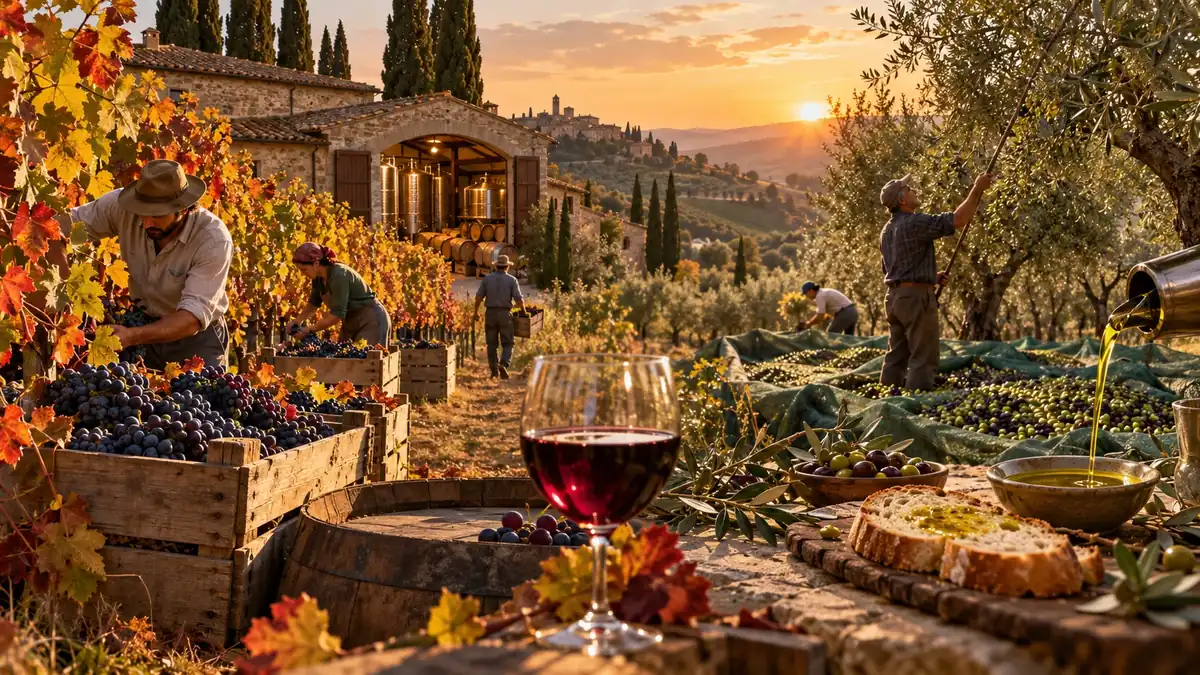
October 2026 – A Time of Transformation
October is the month when the work of an entire season begins to take shape.
After a September devoted to making decisions and choosing the right moment to harvest, a new phase begins across the regions where UFarmer’s producers work.
In the vineyards, grapes become wine. In the olive groves, harvesting begins, and the first olives are transformed into extra virgin olive oil.
This is the time of transformation.
The 2026 grape harvest has revealed an Italy shaped by diverse conditions. Summer heat accelerated ripening in many regions, bringing harvest dates forward, while September rainfall helped restore balance to the grapes in certain areas.
Early assessments suggest generally promising quality, although yields and harvest schedules vary significantly from one region to another.
In Tuscany, for example, regional estimates indicate lower wine production compared to 2025, alongside positive quality assessments. In Friuli Venezia Giulia, initial reports describe good-quality grapes and largely stable yields in certain appellations.
On Mount Etna, however, the harvest still follows the rhythm of the mountain.
Nerello Mascalese, a late-ripening grape variety, continues its journey through vineyards located at different elevations. One vineyard district may have already completed harvesting, while another, just a few hundred meters higher, is still waiting.
It is one of agriculture’s most fascinating characteristics: even within the same region, time does not move at the same pace everywhere.
Meanwhile, the work inside the wineries is changing.
Grape musts are fermenting, sugars are turning into alcohol, and the distinctive characteristics of each grape variety are beginning to emerge.
For some wines, preserving freshness and delicacy is essential. This is true of Vigna Petrussa’s Ribolla Gialla and Villa Petriolo’s I Greti rosé, both of which benefit from stainless steel tanks that help protect their fruity and floral character.
For other wines, the journey will be longer.
Vigna Petrussa’s Friulano will continue aging in large oak barrels, while Villa Petriolo’s Golpaja will develop in concrete tanks, preserving its fruit character while achieving greater harmony.
For Le Cupole by Vini Franchetti, made from four different grape varieties, the process also involves bringing out the distinctive qualities of each component before the final blending.
And for Passorosso, the Nerello Mascalese from Mount Etna, an aging journey of approximately eighteen months begins, divided between concrete tanks and large wooden barrels.
Not all wines require the same amount of time or the same type of vessel.
Stainless steel preserves freshness and delicate aromas. Concrete allows the wine to evolve without introducing wood flavors. Oak barrels help develop harmony, complexity, and structure.
These choices reflect both the nature of the grapes and the identity of the wine the producer aims to create.
But October is not just about wine.
In the olive groves, one of the most eagerly anticipated moments of the year begins: the arrival of the new season’s olive oil.
In Tuscany, early indications for the 2026/2027 olive oil season are particularly encouraging. The Consorzio Toscano IGP forecasts production above the average of the past ten years, with generally healthy olives and favorable quality prospects.
In Villa Petriolo’s olive groves, the Frantoio, Moraiolo, Leccino, and Mignolo cultivars contribute their distinctive characteristics to an extra virgin olive oil rich in herbal aromas, with a harmonious balance of bitterness and peppery intensity.
In Puglia, meanwhile, the new season presents significant differences between areas. While some provinces anticipate lower production, the Lecce area is showing signs of recovery, partly thanks to newly planted olive groves featuring varieties resistant to Xylella.
This is the home of Tenute Martino’s Colette Collection, where Leccino and Pechioline olives produce an extra virgin olive oil with a more delicate, harmonious profile.
Harvesting the olives is only the first step.
Once picked, the fruit must be handled carefully and transported quickly to the olive mill.
There, the olives are washed, crushed, and cold-processed, with the aim of preserving the oil’s aromatic richness and natural characteristics.
After months spent watching the olives grow and ripen, just a few hours of processing are enough to create something entirely new.
And it is in freshly extracted olive oil that autumn reveals one of its most distinctive aromas.
Freshly cut grass, olive leaves, artichoke, green apple. Sensations that express the fruit, the variety, and the land from which it comes.
October therefore brings two seemingly different, yet deeply connected activities to olive mills and wineries.
Wine begins a journey that, in many cases, will take months, sometimes years, before reaching its fullest expression.
Extra virgin olive oil, on the other hand, can already tell the story of the new harvest through its fresh aromas and newly developed character.
The kitchen follows this transformation too.
Richer, more comforting dishes return to the table: legume soups, traditional Tuscan ribollita, mushrooms, fresh pasta, roasts, and slow-cooked specialties.
These flavors find new harmony with our producers’ wines and become even more appealing when paired with a finishing drizzle of extra virgin olive oil.
Every product also tells the story of its homeland through the food served at the table.
September taught us that choosing the right moment is essential.
October shows us that this choice is only the beginning.
Because after the harvest come more steps, more care, and more decisions.
A fermentation to monitor. A wine to guide through its aging process. An olive to process quickly. An aromatic balance to preserve.
Behind every bottle lies not only the fruit of a season, but also the work required to transform it into something that preserves its identity.
In the vineyards, nature has completed most of its work.
In the olive groves, the harvest finally brings the fruit to the mill.
Now, it is the producer’s knowledge and expertise that guide the journey.
Summer led us toward the harvest.
September brought us to the moment of decision.
October takes us into the heart of transformation.
Because the harvest is the result of an entire season.
But transforming it into quality wine or olive oil means carrying that story forward.
Giving shape to the harvest.