


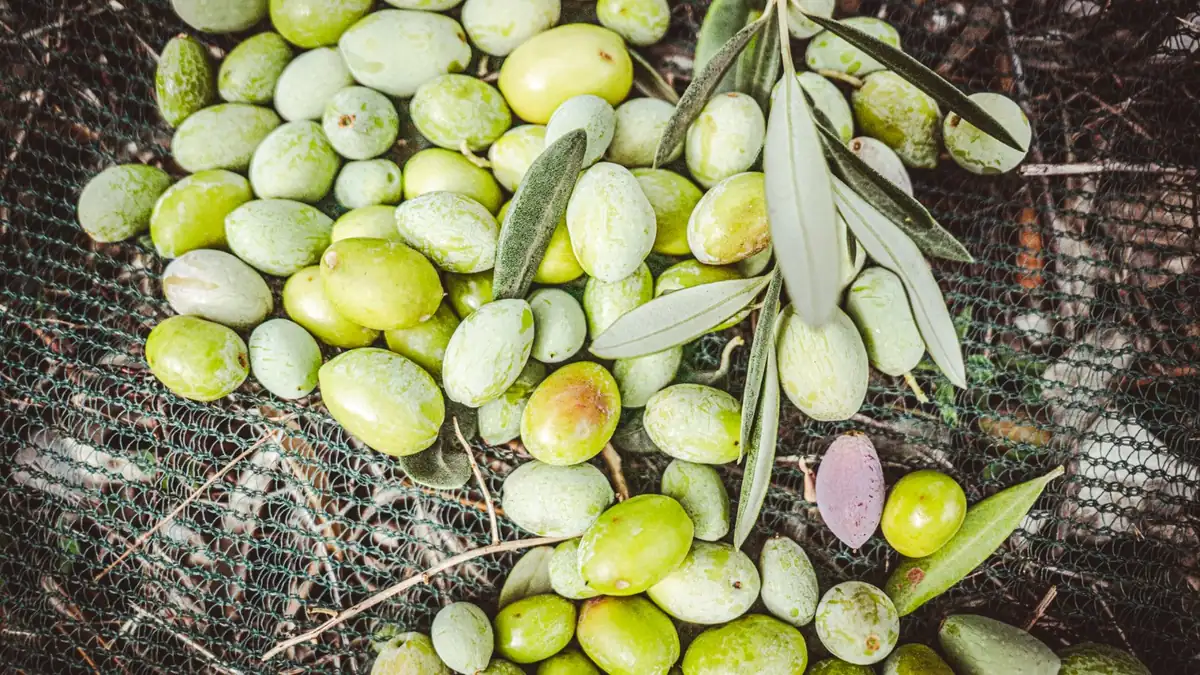
Between filtered and unfiltered olive oil there is no absolute winner. There is the right oil for the way you use it. Unfiltered oil is oil fresh from the mill. It is cloudy because it contains micro-particles of olive pulp and droplets of water in suspension: it is fragrant and lively, but it should be used quickly. Filtered oil is the same extra virgin after filtration, a purely mechanical step that removes water and residues. It is clearer and, above all, more stable over time. If you buy new oil and finish it in a few weeks, the cloudy one is a treat. If you stock up for the whole year, choose filtered. Below you will find out why, with sources, plus some practical tips on storing it well.
In short
- Filtration is not a chemical treatment: it separates the vegetation water and fragments of pulp from the oil. The oil remains an extra virgin.
- Unfiltered oil deteriorates sooner: the suspended particles encourage fermentation and oxidation, so it should be used soon.
- Cloudy is not healthier by definition: according to research, filtration helps preserve polyphenols better during months of storage.
- Choose according to timing: new oil to finish in a few weeks? Unfiltered is fine. Stocking up for the year? Filtered is better.
- The enemies are the same for both: light, heat and air.
Contents
- What filtration does
- Unfiltered olive oil: why it is cloudy and what happens in the bottle
- Filtered and unfiltered compared
- Taste: is cloudy oil really more intense?
- Health and polyphenols: is unfiltered oil healthier?
- How long it lasts and how to store it
- Which to choose: practical criteria
- Our point of view
- An oil to follow from tree to bottle
- Frequently asked questions
- Sources
What filtration does
When olives are crushed and the paste goes through the decanter, the oil that comes out is never completely “clean”. It carries tiny fragments of pulp and stone and a little vegetation water, dispersed in micro-droplets. That is why new oil looks veiled, sometimes almost opaque.
Filtration removes exactly these residues. Filters made of cellulose, cotton or other materials are used, often after an initial natural settling. A 2023 scientific review of the effects of filtration describes it as the process that removes solid sediment and moisture to maintain the oil’s shelf life during storage. The authors also point out that the result depends on many factors: the type of filter, the olive variety, the moment when the oil is filtered.
The point to remember is simple: filtering does not mean refining. Refined oil undergoes chemical and heat treatments and belongs to a different product category. Filtered oil remains an extra virgin in every respect. The category of an olive oil depends on the chemical, physical and sensory parameters set by the regulations, not on whether it is clear or cloudy.
Unfiltered olive oil: why it is cloudy and what happens in the bottle
Unfiltered oil is oil “as it comes out of the mill”. In Italy we know it well: it is the new oil of November, green and peppery, to pour over freshly toasted bruschetta. Its charm lies right there, in its immediacy.
The problem comes with time. Left to rest, unfiltered oil forms a deposit at the bottom called morchia, a mixture of water and organic residues. It is not toxic and does not mean the oil is poor. But it is living matter: the enzymes and micro-organisms in the watery part can start fermentation. Over the months this leads to defects such as fusty, muddy sediment or rancid notes.
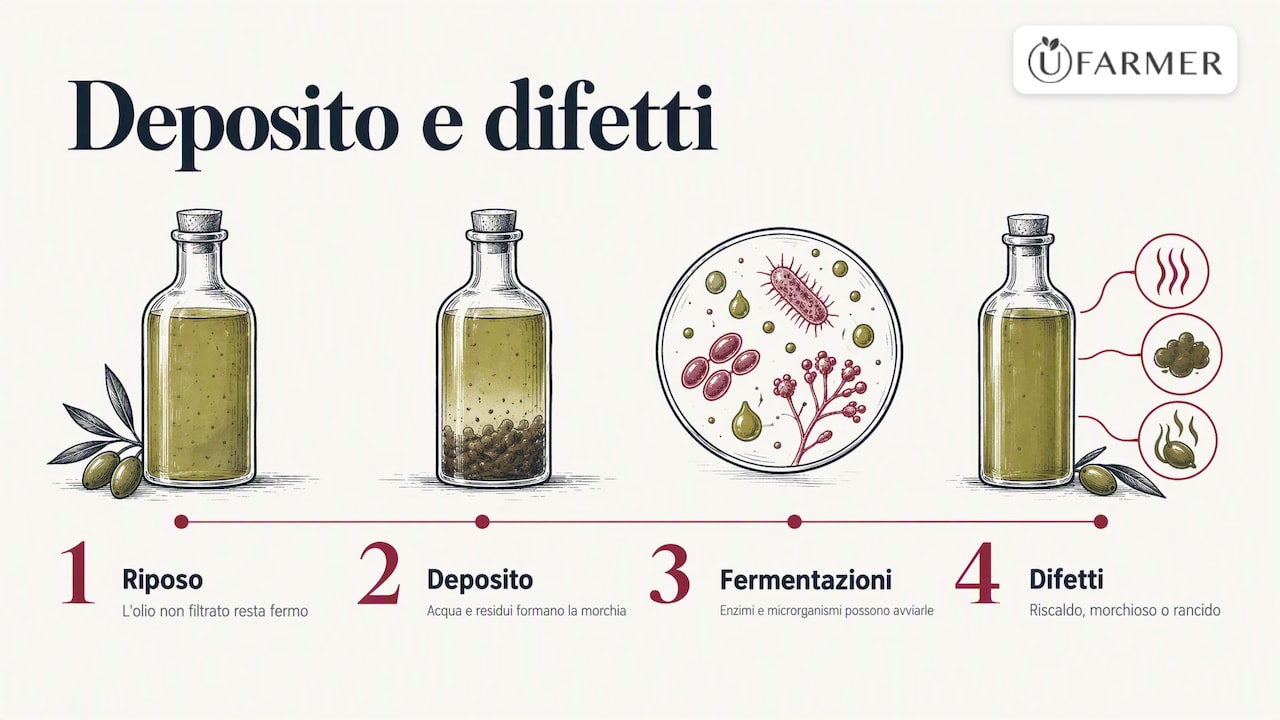
A technical article by Teatro Naturale on filtration as a defence against enzymatic oxidation (in Italian) explains exactly this mechanism: it is in the water dispersed in the oil that enzymes attack the phenolic compounds. Less water, less degradation.
That is why many careful producers let the oil settle for a few weeks and then filter it. Others rack it periodically to separate it from the deposit.
Filtered and unfiltered compared
| Unfiltered oil | Filtered oil | |
|---|---|---|
| Appearance | Cloudy, veiled, with a deposit at the bottom | Clear and bright |
| What else it contains | Water micro-droplets and fragments of pulp | Almost nothing besides the oil |
| Taste when young | Very lively, sometimes more “rustic” | Clean, sharp, more consistent |
| Evolution over time | Fast: risk of defects after a few months | Slow: more stable profile |
| Polyphenols over time | Break down faster | Are better preserved |
| When to use it | Straight away, within a few weeks of opening | Throughout the olive oil season |
| Ideal for | New oil, tastings, autumn bruschetta | Year-round stock, everyday use, gifts |
Taste: is cloudy oil really more intense?
Many people find unfiltered oil more flavourful, and when freshly pressed it can seem so. The suspended particles give body and a “fuller” feel in the mouth. But bitterness and pungency, the two notes that mark a great extra virgin, come from polyphenols, not from cloudiness. A well-filtered oil, made from healthy olives picked at the right time, stays just as bitter and peppery as its cloudy twin.
The difference shows later. Unfiltered oil changes quickly: after a few months the fruitiness can fade and unpleasant notes can appear. Filtered oil, on the other hand, keeps its cleanness and balance for longer. If you want to train your palate to recognise these nuances, taste it the way professional tasters do: a small sip, spread around the whole mouth down to the throat, where you feel the pungency.
A small exercise to try at home: if you have a cloudy oil that has been open for three or four months, taste it next to a filtered oil from the same harvest. You often notice the difference on the nose even before the palate.
Health and polyphenols: is unfiltered oil healthier?
It is the most common doubt, and the answer is less obvious than people think. The idea comes from an intuitive line of reasoning: if unfiltered oil contains “more”, it must be better for you. In reality, what it contains in addition is mostly water and plant residue.
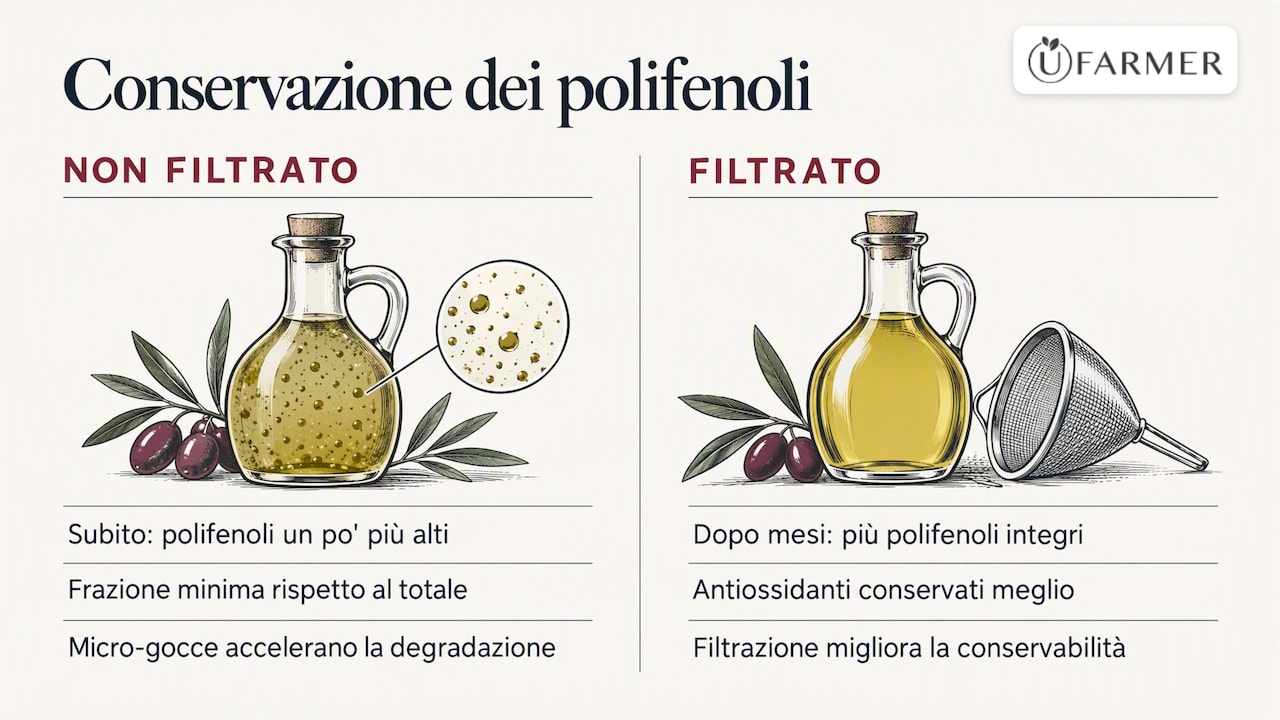
It is true that some polyphenols dissolve in the water micro-droplets. That is why freshly made cloudy oil can show slightly higher values. But, as an analysis by Teatro Naturale on filtered and unfiltered oil (in Italian) notes, in a quality oil that fraction is minimal compared with the total. Above all, it does not last: the same conditions that keep it in suspension speed up the breakdown of phenolic compounds.
Studies point in the same direction. Research published in the European Journal of Lipid Science and Technology compared filtered and unfiltered oils stored at 25 °C and 40 °C to assess the effects of filtration and dehydration on stability. A second study in the same journal measured the effect of filter-press filtration on the shelf life of extra virgin olive oil and found that antioxidants are better preserved. In practice, after a few months filtered oil can have more intact polyphenols than the cloudy oil it started from.
Two notes of caution. First: polyphenol content depends far more on variety, olive ripeness and extraction than on filtration. Second: an oil is not a medicine. If you follow a specific diet for a health condition, talk to your doctor or a dietitian rather than relying on the words “unfiltered”.
How long it lasts and how to store it
Here the difference between the two oils is clear. The International Olive Council, in its good practice guide for consumers, names oxidation as one of the main threats to any edible oil: oxygen from the air, or finely dispersed in the oil, degrades it until it turns rancid.
If you have an unfiltered oil
- Use it soon: the IOC recommends finishing any oil within 1-3 months of opening, and cloudy oil is the one that suffers most.
- Rack it: after a few weeks, gently pour the clear oil into another clean bottle and leave the deposit at the bottom.
- Do not shake it: stirring up the sediment puts it back into suspension and speeds up the processes you want to avoid.
- Buy a little at a time: two half-litre bottles are better than a five-litre tin that will stay open for months.
Rules for both
- Stable temperature: the IOC good practices for storage give a range of 13 to 25 °C. At home that means away from the hob, the oven and sunny windows.
- In the dark: dark glass or a tin, and the bottle inside a cupboard, not on the worktop.
- Little air: always close the cap, and when the bottle is nearly empty do not keep it open for weeks.
- No fridge: intense cold makes the oil partly solidify. It does not ruin it, but sudden temperature changes do it no good.
Which to choose: practical criteria
Instead of asking which one is “better”, ask yourself these four questions.
- How quickly do you finish it? If a half-litre bottle lasts two or three weeks in your home, unfiltered is perfect. If you buy a lot and use it a little at a time, go for filtered.
- When do you buy it? In November and December cloudy new oil is at its best. In spring or summer an unfiltered oil from the previous season already has many months behind it: better a filtered one.
- How do you use it? Raw on bread, on pulses or on a black cabbage soup, young cloudy oil gives its best. For every day, cooking included, filtered oil is more reliable.
- Is it a gift? A gift travels, sits in the pantry and is sometimes opened weeks later. In this case filtered is the safest choice, unless you know it will be tasted straight away.
One last tip: look at the label. Some information on the label is mandatory, some optional. Among the optional details, if present, the harvest season tells you how young the oil is. For an unfiltered oil it is the most useful detail of all.
Our point of view
We work every day with small Italian olive oil producers and we see how appealing the cloudy bottle is. It conveys something artisanal, close to the tree. We understand that feeling well: it is the same one we have in November when the new oil arrives.
At the same time, we believe the quality of an extra virgin is decided long before filtration. It is decided in the olive grove: in the care of the trees, in the timing of the harvest, in the short time between picking and milling. These are the choices we follow closely when we select the producers we work with. If the oil is good, filtering it or not is a choice about how to bring it to your table at its best.
That is why our advice is always the same: no prejudice about colour. A clear oil is not “less natural” and a veiled oil is not necessarily “more genuine”. Ask yourself when you will open it and how you will store it. And if you can, taste it: the palate is a far more honest judge than the eye.
An oil to follow from tree to bottle
If the subject fascinates you, there is a concrete way to experience the oil cycle up close: adopt an olive tree. With UFarmer you choose an olive tree from a small, selected Italian producer, starting from €69. You follow the season with updates from the field and receive the extra virgin olive oil according to the adoption calendar.
It is also a gift idea that works well in the run-up to the holidays. The adoption certificate with your message arrives straight away by email, even on the day you choose, so it also works as a last-minute gift. You can personalise the packaging, at an extra cost, with vinyl lettering, a wooden tag or a personal label. If you would rather have something to open under the tree, tasting boxes are the only option that can arrive by Christmas. You will find all the details on how adoption works.
Frequently asked questions
Which is better, filtered or unfiltered olive oil?
It depends on how quickly you use it. Unfiltered oil is excellent when freshly made and should be finished soon, while filtered oil keeps its qualities for longer. For a stock that has to last all year, filtered is the safer choice.
How long does unfiltered olive oil last?
Less than filtered oil, because water and suspended particles speed up fermentation and oxidation. The International Olive Council recommends finishing any oil within 1-3 months of opening and storing it in the dark, between 13 and 25 °C: for unfiltered oil this matters even more. Racking it to separate it from the deposit helps.
Is the sediment at the bottom of the bottle harmful?
No, it is a natural deposit of water and pulp residues and it is not harmful. However, it is biologically active and over time it can pass defects such as muddy sediment or fusty notes to the oil. It is better to separate the clear oil from the bottom by gently racking it.
Does unfiltered olive oil have more polyphenols?
When freshly made it may have slightly more, but the difference is small and tends to disappear over the months. According to studies, filtration helps preserve antioxidants better during storage. Variety, olive ripeness and extraction matter much more.
Can I filter olive oil at home?
You can rack it: let the bottle rest for a few weeks, then slowly pour the clear oil into a clean, dark container and leave the deposit at the bottom. It is not true filtration like the one done at the mill, but it reduces contact with the sediment.
Sources
- Effects of Filtration Processes on the Quality of Extra-Virgin Olive Oil: Literature Update (PMC, 2023)
- Teatro Naturale: filtering extra virgin olive oil to reduce enzymatic oxidation (in Italian)
- Teatro Naturale: filtered or unfiltered extra virgin olive oil? (in Italian)
- Effect of filtration on virgin olive oil stability during storage (European Journal of Lipid Science and Technology, 2006)
- Shelf life and quality of olive oil filtered without vertical centrifugation (European Journal of Lipid Science and Technology, 2015)
- International Olive Council: good practices for consumers
- International Olive Council: good practices for olive oil storage