


If an extra virgin olive oil catches your throat and leaves a hint of bitterness on your tongue, it is not “too strong” and it is not acidic. Almost always it is the opposite: it is a fresh oil, rich in polyphenols, made from healthy olives and processed well. Bitterness and pungency are two of the three qualities a taster looks for in an extra virgin, together with fruitiness. In this guide we look at where these sensations come from, why a peppery kick alone is not always enough to say an oil is good, what the most common defects are, how to taste oil at home (bread included) and which dishes bring out the best in an intense oil.
In short
- Bitterness and pungency are qualities, not defects: they come from the olive’s phenolic compounds, in particular oleocanthal and oleacein.
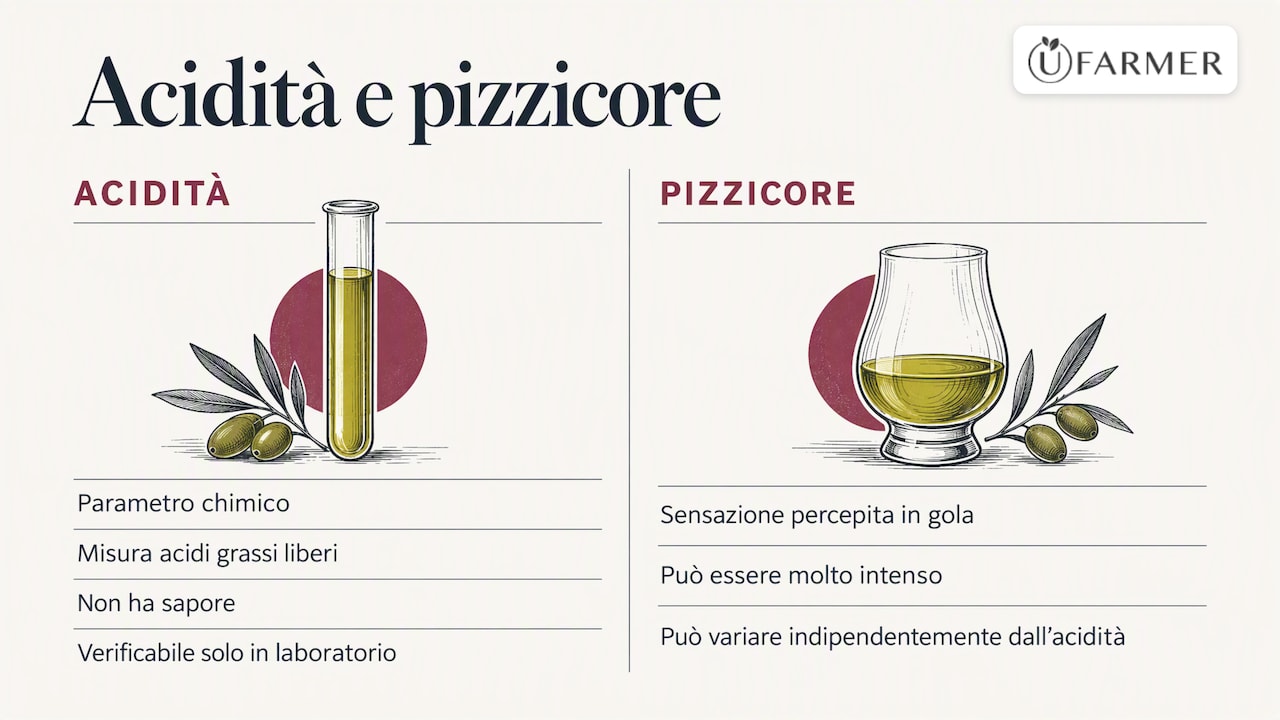
- The peppery kick is not acidity: acidity is a chemical value measured in a laboratory and cannot be tasted.
- On its own it is not enough: an oil can be peppery and still be defective. What counts is a clean fruitiness and no smell of rancid, mould or vinegar.
- Bread is for cleaning the palate, not for tasting: the crumb absorbs the oil and dulls bitterness and pungency.
- An intense oil calls for bold dishes: pulses, soups, bitter greens, bruschetta, grilled meat.
Contents
- Where bitterness and pungency come from
- Why olive oil catches your throat
- The most common defects to recognise
- How to taste olive oil at home
- Intense, medium or light: which to choose
- Pairings: bitter, peppery oil at the table
- Bitterness mellows over time
- Our view
- Adopting an olive tree: new oil as a gift
- Frequently asked questions
- Sources
Where bitterness and pungency come from
The olive is a fruit rich in substances that defend it from outside attacks. The most important for taste are phenolic compounds, which partly pass into the oil during crushing and extraction. They are what give extra virgin olive oil its character.
According to an in-depth article by Teatro Naturale on the secrets of bitterness and pungency (in Italian), the two sensations are attributed to phenolic compounds, and in particular to two secoiridoids: oleocanthal and oleacein. The same article reports a study of 21 samples of Greek oil in which oleocanthal ranged from 34.6 to 154.6 mg/L and oleacein from 11.5 to 191.9 mg/L. In other words: even among oils from the same country the differences are huge, and you can taste them.
In practice:
- Bitterness is felt on the tongue, especially at the back. It is linked to oleuropein and other secoiridoids and is more noticeable when the olives are picked still green or just turning, that is, when they start to change colour.
- Pungency is felt in the throat, a few seconds after swallowing. It is the famous peppery “scratch”, and the main cause is oleocanthal.
How bitter and pungent an oil will be depends on several factors:
| Factor | How it affects the oil |
|---|---|
| Cultivar (olive variety) | Some varieties are naturally richer in polyphenols and give more intense oils, others sweeter oils |
| Time of harvest | Green or turning olives give more bitterness and pungency; ripe olives give softer oils |
| Processing | A short time between harvest and milling and controlled temperatures preserve polyphenols |
| Age of the oil | New oil is at its most intense; over the months bitterness and pungency fade |
| Storage | Light, heat and air use up polyphenols faster |
That is why two extra virgin olive oils, both excellent, can seem like two different products: one almost sweet, the other making you cough at the first sip.
Why olive oil catches your throat
The peppery sensation has a curious explanation. Oleocanthal acts on pain and inflammation receptors in the throat, through a mechanism researchers have compared to that of ibuprofen. It is no coincidence that many tasters cough during a tasting: among themselves they describe an oil as a “one-cough” or “two-cough” oil to indicate its intensity.
In the same Teatro Naturale article, oleocanthal is described as an anti-inflammatory and neuroprotective agent. It is an interesting field of study, but a peppery oil is still a food, not a remedy: if you suffer from gastritis or reflux and notice that very intense oils bother you, talk to your doctor or a nutritionist before changing your habits.
The peppery kick is not acidity
This is the most common confusion. Many people feel the peppery kick and think: “this oil is acidic”. In fact, the acidity of an extra virgin olive oil is a chemical parameter that measures free fatty acids. It has no taste and can only be checked with a laboratory analysis. An oil can have very low acidity and be very peppery, or the other way round.
When the peppery kick is not enough
Be careful, though, not to treat pungency as an absolute guarantee. As Cookist points out when writing about oil that catches your throat (in Italian), the peppery kick is one of the signs of quality but on its own it is not enough: an oxidised oil can also give a burning feeling in the throat, for different reasons. The rest of the tasting makes the difference. A good bitter, peppery oil also has a clean fruitiness, meaning fresh aromas of olive, grass, artichoke, tomato or almond. If, on the other hand, your nose picks up unpleasant smells, that burning is not a quality.
The most common defects to recognise
Defects are almost always easier to detect with the nose than with the mouth. Here are the ones you come across most often, even in oils sold as extra virgin.
| Defect | How to recognise it | What causes it |
|---|---|---|
| Rancid | Smell of old dried fruit, stale walnuts, wax crayons | Oxidation: old or badly stored oil, exposed to light, air and heat |
| Fusty | Sweetish, flat smell of cooked olives | Olives piled up too long before milling, which have fermented |
| Musty | Damp, cellar-like, mushroomy smell | Olives kept in damp places for days |
| Winey | Smell of wine or vinegar | Fermentation of the olives with formation of acetic acid |
| Muddy sediment | Smell of mud, of stale sediment | Oil left in contact with the sediment in its containers |
The practical tip: if you smell one of these, the fact that the oil is peppery no longer matters. A quality extra virgin olive oil must have no defects, and rancidity in particular is the most common sign of an oil that is too old or badly stored.
Another useful clue is the feeling the oil leaves in your mouth after tasting. A good oil is persistent and pleasant, and your mouth feels clean. A tired oil leaves a heavy, “greasy mouth” feeling, with no aromas.
How to taste olive oil at home
You don’t need to be a professional taster to tell whether an oil is bitter, peppery and balanced. All you need is a small glass, a few calm minutes and a little attention. Here is the sequence tasting panels use, simplified.
- Pour the oil into a small glass, about a tablespoon. If you have several oils to compare, use one glass for each.
- Warm it in your hand. Cover the glass with the palm of your other hand and hold it for a minute: the warmth releases the aromas.
- Smell. Uncover the glass and take two or three short, deep sniffs. Look for fruitiness (grass, tomato leaf, artichoke, apple, almond) and check there are none of the defects listed above.
- Take a small sip, a few millilitres, and spread it between your tongue and palate.
- Do the “strippaggio”. Keep your teeth almost closed and suck in air firmly, making a little noise. The oil turns into a fine mist in your mouth and brings the polyphenols into contact with your taste buds. This is where you taste the bitterness.
- Swallow and wait a few seconds. The pungency reaches your throat afterwards, often with a cough.
- Judge the persistence. How long do the aromas last? Does your mouth feel clean or greasy?
If you compare several oils, always start with the one that seems most delicate and finish with the most intense. Otherwise a strong oil “masks” the ones that follow.
Bread: useful, but not for tasting
This is one of the most frequent questions. In a technical tasting bread is not used to taste the oil: the crumb absorbs it, holds on to some of its aromas and dulls exactly the bitterness and pungency you want to assess.
Bread is useful between one tasting and the next, to clean the palate. In this case choose:
- plain unsalted or lightly salted bread, such as Tuscan bread, with a simple crust;
- no flavoured breads, strongly flavoured wholemeal or olive oil breadsticks;
- alternatively, slices of green apple (tart, like Granny Smith) and a sip of water at room temperature.
If, on the other hand, you just want to enjoy the oil with friends, bruschetta is perfect. Toasted bread, a pinch of salt and a drizzle of new oil are still the most enjoyable way to get to know an intense extra virgin. Just remember that at that moment you are pairing, not analysing.
Why the glass is blue in competitions
In professional tastings, blue or dark glasses are used. It is not an aesthetic choice: the colour of the oil depends mainly on the variety and the time of harvest, not on quality. A bright green does not necessarily mean a better oil. The coloured glass stops sight from influencing judgement. At home you can get the same effect simply: taste with your eyes closed or have someone else pour the oil.
Intense, medium or light: which to choose
When the label says “intense fruity”, “medium” or “light”, it refers to the overall intensity of the oil, which usually goes hand in hand with bitterness and pungency. No category is better than the others: what changes is how you use it.
| Profile | What you taste | Where it works best |
|---|---|---|
| Light fruity | Delicate aromas, barely noticeable bitterness and pungency | Steamed fish, risottos, white meat, homemade mayonnaise, desserts |
| Medium fruity | Balance between aromas, bitterness and pungency | Mixed salads, grilled vegetables, pasta with vegetables, baked fish |
| Intense fruity | Pronounced bitterness, long pungency in the throat | Pulses, soups, bruschetta, bitter greens, grilled meat |
If you are used to very sweet oils, your first taste of an intense fruity oil may surprise you. That is common: the palate often gets used to it within a few weeks, and at that point a flat oil seems lifeless.
Pairings: bitter, peppery oil at the table
The basic rule is simple: intensity with intensity. A bold oil stands up to bold dishes and makes them better. On a delicate dish, though, it may overpower everything. Use it mainly raw, at the end, once the food is already on the plate.
Pairings that almost always work:
- Pulse soups: ribollita, pasta e fagioli, chickpea soup, cavolo nero and polenta soup. A drizzle of raw oil before serving transforms the dish.
- Bruschetta and fettunta: toasted bread, rubbed garlic, salt and new oil. It is the classic autumn pairing.
- Bitter and seasonal greens: turnip tops, sautéed chicory, puntarelle, grilled radicchio, artichokes.
- Grilled meat: steak, tagliata, lamb. The bitterness of the oil balances the fat of the meat.
- Pinzimonio: raw fennel, celery and carrots dipped in oil, salt and pepper.
- Aged cheeses and buffalo mozzarella, with an intense but clean oil.
- Ripe tomatoes, in a simple salad or on panzanella.
Where to use a more delicate oil: raw fish, shellfish, parmesan risottos, olive oil cakes, mayonnaise. Here bitterness can be overpowering.
An idea for a small tasting with friends: three different oils (light, medium, intense), a plate of boiled beans, a few slices of toasted bread and a pinzimonio. Taste each oil first on its own, then on the food. It is the quickest way to see how much a dish changes with the right oil.
Bitterness mellows over time
New oil, freshly pressed in autumn, is at its most intense. Over the following months bitterness and pungency fade naturally, as the oil settles and polyphenols decrease. It is not a defect: it is the normal life of an extra virgin olive oil. Many people find the oil more balanced after a few months.
To keep this process slow, store your oil like this:
- in the dark, in dark bottles or tins, away from the window;
- somewhere cool, away from the hob and the oven;
- tightly closed, because air speeds up oxidation;
- in quantities that suit how much you use: an open bottle should be finished within a few weeks.
An oil a few years old is not necessarily dangerous, but it has lost its freshness and often turns rancid. If you smell stale walnuts or wax crayons, use it at most to grease a pan, not to dress food.
Our view
When we talk about the oil of the producers we follow, we notice that the question “why is it peppery?” almost always comes with a small worry: “did I buy the wrong oil?”. We think the best answer is not a chemistry lesson but a proper tasting. People who taste a new oil from a small glass for the first time, with the “strippaggio”, usually change their minds in a few seconds.
That is why we believe so much in the link between those who produce and those who consume. Knowing which tree your oil comes from, seeing how the tree changes during the year through seasonal updates, understanding when the harvest happens: all of this helps you read what you taste. A bitter, peppery oil stops being “strong” and becomes the result of precise choices, made by real people, over a year of work.
There is also something we care about: there is no right oil for everyone. There is the right oil for a dish, for a moment, for a palate. That is why we select small Italian producers with different profiles, and we invite you to compare them rather than look for a single “best”.
Adopting an olive tree: new oil as a gift
If you like the idea of getting to know an oil from the tree to the bottle, with UFarmer you can adopt an olive tree in Italy from €69. Choose the olive oil producer, follow the life of your tree through seasonal updates and receive the extra virgin olive oil according to the adoption calendar.
Among the available adoptions you will find, for example, the Villa Petriolo olive tree with IGP extra virgin olive oil, the Biancolilla IGP from Fratelli Bonanno and the Olio EVO 245 from Tenuta Fanton. Three different olive oil producers, three different ways of making extra virgin.
It is also a gift that gets noticed:
- the adoption certificate with your message arrives straight away by email, or on the day you choose for the gift;
- you can personalise the bottles, for an extra charge, with vinyl lettering, a wooden tag or a personal label;
- if you want something to taste straight away, the tasting boxes are the only option that arrives by Christmas, for orders placed by 17 December.
If you want to understand, step by step, what happens after you order, read how adoption works.

Frequently asked questions
Is oil that catches your throat acidic?
No. The peppery kick comes from polyphenols, especially oleocanthal, while acidity is a chemical value that cannot be tasted. To know an oil’s acidity you need a laboratory analysis. A very peppery oil can have very low acidity.
Is an oil that isn’t peppery of poor quality?
Not necessarily. Some olive varieties and later harvests give naturally sweet oils, with little bitterness and little pungency. An oil a few months old is also less peppery than one just pressed. What matters is a clean fruitiness and no defects such as rancidity or mould.
What bread should you use for an olive oil tasting?
In a technical tasting, bread is not used for tasting, because it absorbs the oil and dulls bitterness and pungency. It is only used to clean the palate between one oil and the next: best a plain, lightly salted, unflavoured bread. Slices of green apple and a sip of water work well too.
How can I tell if olive oil has gone off?
Smell it in a small glass after warming it in your hand. A smell of stale walnuts, wax crayons or varnish means a rancid oil; a smell of damp, vinegar or cooked olives means other defects. In these cases the oil is no longer suitable for dressing food, even if it still catches your throat.
Sources
- Teatro Naturale: the secrets of bitterness and pungency in extra virgin olive oil (in Italian)
- Cookist: extra virgin olive oil that catches your throat, why it is a sign of quality (in Italian)