


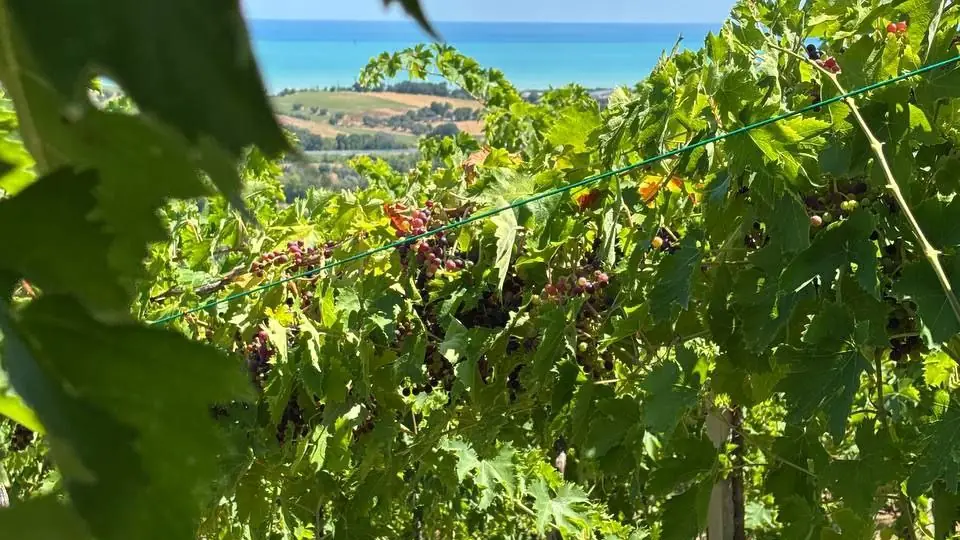
Veraison (in Italian, invaiatura) is the moment when the grape berries stop being green and hard and begin to ripen. White grapes become more translucent and turn towards yellow, while black grapes go from red to black. It happens in the height of summer, usually between late July and August, and from here on every week counts for the grape harvest. In this guide you will find how to recognise it, what happens inside the berry, why some grape varieties get there before others and how winegrowers use this stage to decide when to pick.
In brief
- What it is: the stage in which the berry changes colour, softens and begins to accumulate sugars. It is the start of ripening proper.
- When: in Italy it generally falls between the last ten days of July and August, with differences of up to several weeks between areas and grape varieties.
- How long it lasts: veraison itself can last from 6 to 30 days; the ripening that follows takes on average from 25 to 50 days.
- What changes: sugars rise, acidity falls (especially malic acid), and in black grapes the anthocyanins, that is, the colour pigments, build up.
- Why it matters: this is where the checks begin that lead to the choice of the grape harvest date, and therefore to the style of the wine.
Contents
- What veraison is
- Where it sits in the vine cycle
- When veraison happens in Italy
- What happens inside the berry
- Early and late grape varieties
- The climate is bringing veraison forward
- From veraison to the grape harvest: how the picking date is decided
- Our point of view
- Following veraison up close, even from home
- Frequently asked questions
- Sources
What veraison is
The Italian word comes from the verb “invaiare”, meaning to change colour. In the vineyard it is the most visible sign of the transition from the herbaceous stage, in which the berry grows but stays unripe, to the stage in which it becomes a true fruit.
Up to this point the berry is green, hard and very acidic. It contains chlorophyll, like a small leaf, and contributes little to the plant’s sugars. With veraison the skin loses its chlorophyll and shows the colour typical of the variety. From that moment the vine begins to “fill” the bunch with sugars, water and aromatic compounds.
It is not a switch that flips in a single day. As the teaching material from the University of Teramo on berry ripening explains, the transition happens gradually and may begin on only some of the berries in the bunch. For a few days you will therefore see “patchy” bunches, with already coloured berries alongside berries that are still green.
How to recognise it in the vineyard
If you walk between the rows in late July, these are the signs to look for:
- Colour: in black grapes the first reddish berries appear, then purplish ones. In white grapes the change is more subtle: the berry goes from a dull green to a brighter yellow-green.
- Translucency: the BBCH phenological scale adopted by ERSA Friuli Venezia Giulia describes veraison as berries becoming translucent and/or changing colour according to the variety.
- Texture: if you gently squeeze a berry between your fingers, it feels softer, less firm than a few days earlier.
- Taste: when tasted, the berry is still extremely acidic but loses its harshest “grassy” note.
A practical tip: softening comes before colour. If you want to know whether your vine is entering veraison, touch the berries before you look at them.
Where it sits in the vine cycle
The vine’s annual cycle follows a precise sequence: budburst in spring, flowering, fruit set (when the fertilised flower becomes a tiny berry), berry growth, veraison, ripening and grape harvest. After picking, the plant builds up reserves and goes dormant for the winter.
Researchers describe berry growth with a double sigmoid curve, that is, an “S” shaped curve repeated twice. According to the material from the University of Teramo there are three stages:
- Herbaceous stage: the berry grows quickly through cell division and expansion, accumulates acids and stays green.
- Translucent stage or veraison: growth slows, almost stopping, and the major internal changes begin.
- Ripening stage: the berry regains volume through cell expansion and fills with sugars.
In the international BBCH classification, also used by regional plant health services, berry ripening corresponds to principal growth stage 8. In viticultural bulletins you will often find the code BBCH 81 to indicate the beginning of veraison.
When veraison happens in Italy
There is no fixed date. It depends on the grape variety, the altitude, the vineyard’s exposure and, above all, how the season unfolds. A few real-world reference points help to get your bearings.
In the Veneto Region viticultural bulletin of 10 July 2024, technicians were already reporting the first bunches at the early stage of veraison (BBCH 81) on Merlot and Pinot Noir. In the same vintage, the Assoenologi review of growing cycles across the Italian regions reported that in Friuli Venezia Giulia veraison had begun in the earliest vineyards around the last ten days of July.
As a general guide:
| Area or situation | When it tends to begin | What influences it |
|---|---|---|
| Warm lowland vineyards and the South | As early as July | High temperatures, plenty of light |
| Hills of Central and Northern Italy | Between late July and August | Exposure, altitude, summer rain |
| Mountain vineyards and cool areas | Later in August | Cool nights, shorter season |
| Early varieties (Pinot, Chardonnay) | Earlier than average | Characteristic of the variety |
| Late varieties | Later than average | Long cycle, grape harvest in autumn |
The table is a guide only: every vintage shifts the dates, sometimes by weeks.
How long it lasts
The V.I.S.T.A. project on grape ripening in Sicily gives an indicative duration of 6-30 days for veraison, followed by a ripening period of around 25-50 days. In plain terms: between the first coloured berries and the grape harvest, a good one to two months often go by, depending on the grape variety and the wine the producer wants to make.
What happens inside the berry
Veraison is not just a matter of colour. Inside the berry almost everything changes, and in a precise order: according to the University of Teramo, the softening of the berry coincides with the start of sugar accumulation and comes a few days before the skin changes colour and growth resumes.
| Component | Before veraison | After veraison |
|---|---|---|
| Skin | Green, rich in chlorophyll | Takes on the colour of the variety |
| Pulp | Hard, compact | Softens |
| Sugars | Few | Increase steadily |
| Acidity | Very high | Falls, mainly through the reduction of malic acid |
| Colour (black grapes) | Absent | Anthocyanins build up |
| Tannins | Green, astringent | Begin to change |
| Aromas | Grassy notes | The variety’s aromas form |
| Volume | Growth almost at a standstill | The berry swells again |
Two steps deserve a little more explanation.
Acidity. There are two main acids in the berry: malic and tartaric. During ripening it is mainly malic acid that falls, the one that gives the sensation of an unripe apple. The V.I.S.T.A. project points out that it is important to preserve an adequate level of tartaric acid, on which the total acidity of the must depends. Grapes with too little acidity give flat wines that age less well.
Colour. Anthocyanins are the pigments that give red wines their colour. They form in the skin and begin to build up precisely with veraison. This is why red wine producers follow this stage so closely: an even, uniform veraison is the starting point for a full colour.
Early and late grape varieties
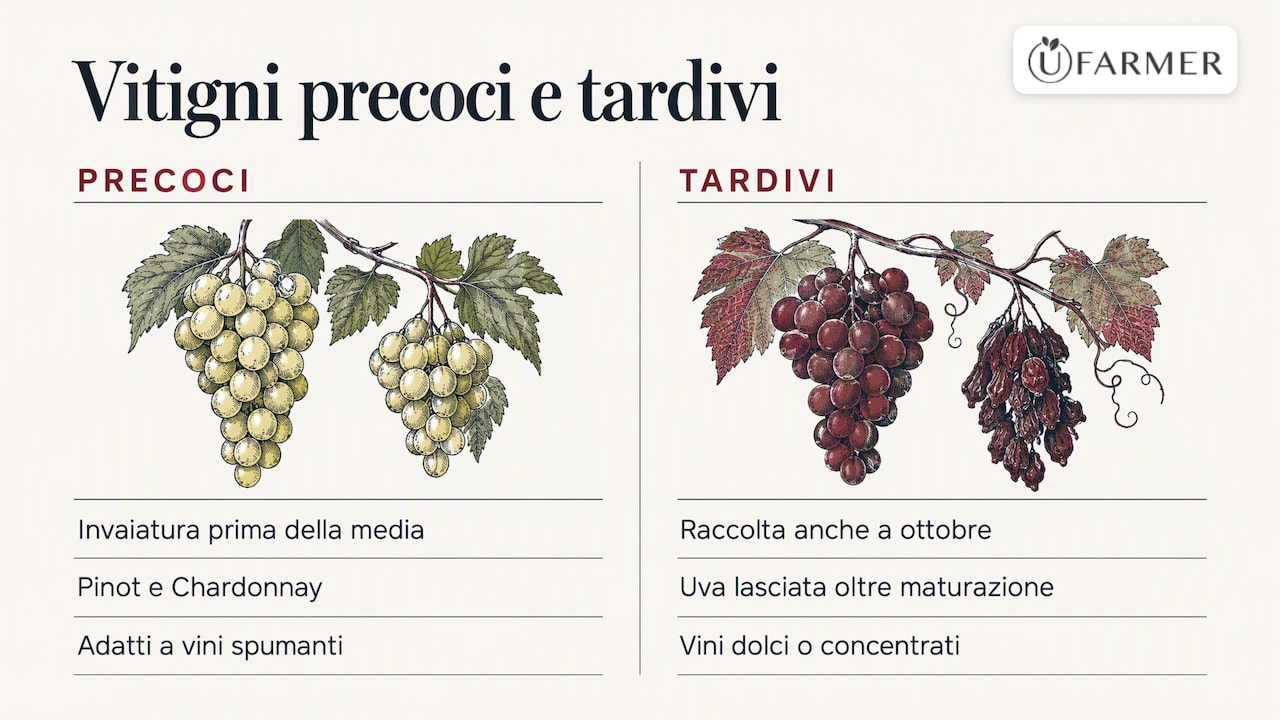
Every variety has its own calendar. Early varieties reach veraison and the grape harvest before the average; late ones need more time and may be picked as late as October.
Among the best-known early wine grape varieties in Italy are the Pinots (Noir, Gris and Blanc) and Chardonnay. The Pinot Noir entry in the Masaf National Register of Grape Varieties describes its veraison as “somewhat early”. It is no coincidence that these grapes are often the base of sparkling wines: bubbles call for grapes with still lively acidity, and varieties that ripen early lend themselves well to this.
Field data confirm it. In 2024, according to Assoenologi, the grape harvest in Veneto started in the last week of August precisely with early varieties such as Pinot Gris and Pinot Noir.
At the opposite extreme are the long-cycle varieties and late harvests, in which the producer leaves the grapes on the vine beyond normal ripeness to concentrate sugars and aromas. Here veraison is only the first step on a much longer journey, which leads to sweet or very concentrated wines.
Be careful not to confuse things: table grapes also have early and late varieties, but they follow different criteria from wine grapes.
The climate is bringing veraison forward
Over the last few decades winegrowers and researchers have observed a clear trend. According to the review by Palliotti and co-authors in Italus Hortus, global warming brings forward the start of the phenological stages and speeds up ripening, with sugars rising and acids falling faster.
It sounds like good news, but it is not always. The same authors note that too rapid a sugar ripening can create imbalances: lower acidity, higher pH, possible knock-on effects on the wine’s aromas and stability. In practice the grapes are “sweet” before they are truly ripe in colour and aromas.
This is why many producers work on canopy management, that is, the leaves that shield the bunches from the sun, and on vineyards at higher altitude or with better exposure. A study on Northern Italy covering the vintages from 1986 to 2022 shows how the picking date is adapted to berry quality parameters: the sugar to acidity ratio for Chardonnay, the health of the bunches for Teroldego.
From veraison to the grape harvest: how the picking date is decided
After veraison the most delicate work of the year begins: working out the right day to pick. It is not enough for the grapes to be sweet. The V.I.S.T.A. project distinguishes three types of ripeness:
- Technological ripeness: assessed mainly through sugars and acidity. It tells you how much alcohol the wine may have and how fresh it will be.
- Phenolic ripeness: concerns phenols, anthocyanins and tannins. It is decisive for red wines, because colour and softness depend on it.
- Aromatic ripeness: concerns the build-up of the variety’s typical aromas. It matters a great deal for aromatic whites.
The ideal grape harvest is a balance between these three, depending on the wine the producer wants to make. Grapes for a sparkling wine base are picked earlier, while acidity is still high. Grapes for a red meant for ageing can stay in the vineyard longer.
Ripening curves
To decide, technicians build ripening curves. In short, the procedure is:
- Berries are sampled at regular intervals, from different parts of the vineyard and from different bunches.
- The key parameters are measured: sugars, total acidity, pH and, for black grapes, the phenolic components.
- The values are plotted on a graph over time: the sugar curve rises, the acidity curve falls.
- The curves are compared with the target wine and with the forecast weather.
- The date is chosen, often plot by plot.
The research by Guidoni and Ferrandino of the University of Turin stresses that following berry growth and the build-up of its compounds serves precisely to predict the picking date, the order in which to pick the plots and the most suitable winery technique. The same authors point out that the course of ripening varies greatly depending on grape variety, environment, weather patterns and growing techniques.
Our point of view
For anyone following a vineyard through the year, veraison is one of the easiest stages to notice. In spring the vine is all leaves and shoots. Then, within a few summer weeks, the bunches change colour and you realise the grape harvest is no longer far off.
For us, this is why it makes sense to follow the season rather than just buy a bottle. The wine that arrives at your home is the fruit of a year’s work, and stages like veraison explain why every vintage is different: a warmer July, some rain in August, a vineyard higher up or lower down all change what ends up in the glass.
That is why we work with small, carefully selected Italian producers and the season reaches you through the producer’s updates. Not all wineries work in the same way, nor to the same timings: that is exactly what makes every adoption unique. We suggest looking at the vineyard with fresh eyes even when you are not in the countryside. Knowing how to recognise veraison, or understanding why a producer waits a few more days before picking, makes every sip more mindful.
Following veraison up close, even from home
If the idea of following a vineyard from budburst to grape harvest appeals to you, with UFarmer you can adopt a vineyard from a small, carefully selected Italian producer, from 85 €. You receive the adoption certificate with a dedication, updates from the producer through the season and, at the end of the natural cycle, your wine at home, according to the adoption calendar.
It is also an original gift for wine lovers: the certificate arrives straight away by email, or on the day you choose. For a fee you can personalise the bottles with vinyl lettering, a wooden tag or a personal label, even after purchase. You will find all the options among the vineyard adoptions, and if you want to understand the steps in detail there is the page on how adoption works.
Would you rather taste before adopting? Tasting boxes introduce you to a producer’s wines, and they are the only option that can arrive in time for Christmas (for orders placed by 17 December): you will also find them among the Christmas gifts.
Frequently asked questions
What does veraison mean?
It is the stage in which the grape berry changes colour, from green to the colour typical of the variety, and ripening begins. Along with the colour, the texture changes, becoming softer, as does the composition: sugars rise and acidity falls. The Italian term, invaiatura, comes from the verb “invaiare”, meaning to change colour.
Which grapes ripen early?
Among wine grapes, the best-known early varieties in Italy are the Pinots (Noir, Gris and Blanc) and Chardonnay. They reach veraison and the grape harvest before the average and are often used for sparkling wines. The exact date still changes every year depending on the climate and the area.
What are grape ripening curves?
They are graphs showing how sugars, acidity, pH and, in black grapes, the phenolic components change over time. They are built by sampling berries at regular intervals after veraison. They help to tell when the grapes have reached the right balance for the wine you want to make.
How do grapes become wine?
After the grape harvest the grapes are pressed and the must ferments: yeasts turn the sugars into alcohol. For reds the must stays in contact with the skins, from which it takes colour and tannins; for whites it generally does not. Then comes ageing, in steel, wood or bottle, before the wine is ready.
Does veraison happen at the same time every year?
No. It depends on how the season unfolds, on the grape variety and on the position of the vineyard. In recent decades climate warming has tended to bring the vine’s stages forward, veraison included.
Sources
- University of Teramo, teaching material on berry ripening (in Italian)
- ERSA Friuli Venezia Giulia, BBCH and Baggiolini phenological scales for the vine (in Italian)
- Veneto Region, viticultural bulletins (in Italian)
- Assoenologi, the vine’s growing cycles across the Italian regions (2024) (in Italian)
- V.I.S.T.A. project, grape ripening process and sensory analysis (in Italian)
- Masaf, National Register of Grape Varieties: Pinot Noir (in Italian)
- Palliotti and co-authors, grape ripening and canopy management (Italus Hortus) (in Italian)
- Four decades in the vineyard: the impact of climate change (Northern Italy, 1986-2022)
- Guidoni and Ferrandino, Grape ripening (University of Turin) (in Italian)