


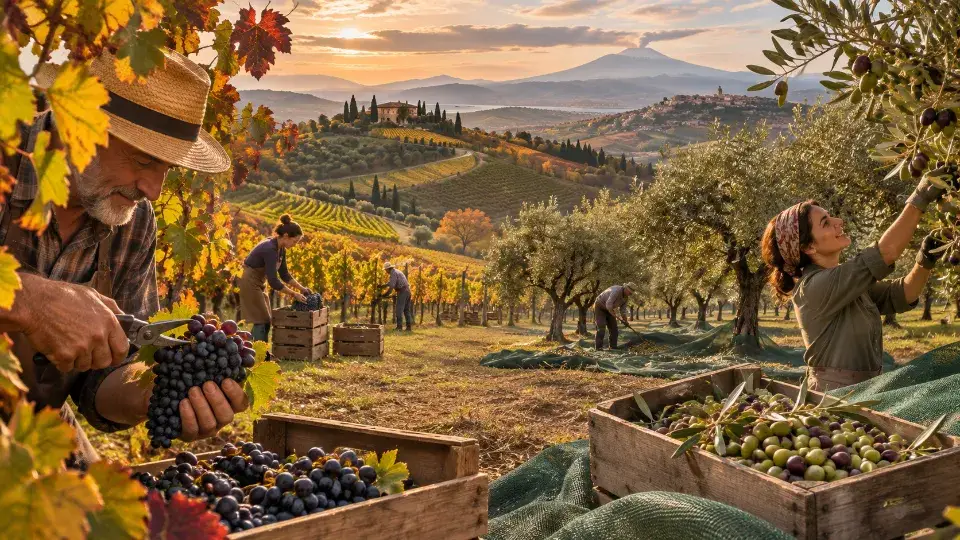
Grape harvest and olive harvest 2026: one Italy, many stories to tell
From the hills of Friuli to the slopes of Etna, from the Tuscan olive groves to Salento: a journey through the seasons, the people and the places behind UFarmer’s products.
Every harvest tells the story of a year
There are moments in the year when the countryside seems to hold its breath. The sun sits lower, the days grow shorter and, among the vine rows and olive groves, the time comes to gather what nature and human work have built together.
The grape harvest and the olive harvest are much more than dates on the farming calendar. They are the result of months of waiting, watching, decisions and, at times, worries. Every bunch of grapes and every olive carries the story of the season just gone.
Throughout 2026, with our monthly timelines, we have taken everyone who chose UFarmer on a journey into this story. We followed the fruit as it ripened, got to know our producers’ land and told the delicate passage from the countryside to the winery and the olive mill.
Now that autumn brings the first results, it is time to look together at what this vintage has taught us.
Grape harvest 2026: less wine, but an Italy full of nuances
According to the first estimates released on 18 November by the International Organisation of Vine and Wine (OIV), Italian production in 2026 should settle at around 41 million hectolitres, about 8% less than in 2025.
An important figure, reflecting a season marked in many areas by heat, drought and irregular rainfall.
But Italian wine cannot be described by a single national percentage. Every region, every hill and even every single vineyard faced different conditions.
In some areas the harvest came early, in others it stretched well into autumn. Sometimes the bunches were less plentiful, but the condition of the grapes raised encouraging expectations for quality. It is precisely this variety that makes the Italian wine landscape so fascinating.
From Friuli to Tuscany: when the land makes the difference
In the Colli Orientali del Friuli, among the vineyards of Prepotto and the Judrio valley, we followed the journey of the Friulano and the Ribolla Gialla of Vigna Petrussa.
The heat sped up ripening, but the first assessments from the Friuli DOC described an overall positive harvest, with quantities in line with previous vintages and good quality grapes.
Here two wines give different readings of the same land: the Friulano seeks harmony through ageing in large barrels, while the Ribolla Gialla keeps its fresh, floral character while resting in steel.
Heading down to Tuscany, the landscape changes and so does the story of 2026. Regional assessments pointed to a production drop of more than 20%, together with favourable prospects for quality.
In Cerreto Guidi, Villa Petriolo showed us two faces of Sangiovese. On one side Golpaja, a red in which Sangiovese meets a small share of Merlot; on the other I Greti, a rosé that expresses the same grape through freshness, red fruit aromas and delicate floral notes.
Further south, among the hills of Sarteano, we got to know Le Cupole by Vini Franchetti. Merlot, Cabernet Franc, Cabernet Sauvignon and Petit Verdot follow different paths before coming together in the blend. Their proportions change from one vintage to the next, to find a new balance every time.
Three different stories that tell the same truth: a wine’s personality comes from the character of the land and the choices of those who farm it.
From Abruzzo to Etna: why knowing every vineyard matters
In Abruzzo, heat and drought put many vineyards to the test in 2026. A complex season, which made decisions about when to pick and how to keep the grapes fresh even more important.
Among the hills of Città Sant’Angelo, Tenuta Fanton showed us how versatile Montepulciano and Trebbiano d’Abruzzo can be. From still wines to bottle-fermented sparkling ones, each interpretation shows how much a wine can change depending on the choices made in the winery.
Further south still, on Etna, the harvest follows its own calendar. Here altitude, exposure and the volcanic soils set different ripening rhythms.
Passorosso by Vini Franchetti is made from Nerello Mascalese grown in several contrade on the northern side of the volcano. Malpasso, Guardiola, Santo Spirito, Favazza and Arcuria all contribute to a wine that brings together many expressions of the same mountain.
It is a striking example of what we discovered on this journey: even when there is only one grape variety, the land can tell very different stories.
Olive oil season 2026/27: the scent of new oil
While the grape harvest was coming to an end in the vineyards, another story was taking shape in Italy’s olive groves: the story of the new oil.
The 2026/27 olive oil season also shows major differences between areas. In Tuscany, the Consorzio dell’Olio Toscano IGP announced particularly favourable prospects, with production expected to be 35 to 40% above the average of the last ten years.
At Villa Petriolo, on the hills of Cerreto Guidi, we followed four cultivars: Frantoio, Moraiolo, Leccino and Mignolo. Together they make an extra virgin olive oil with a grassy character, notes of green apple and a balance of bitter and peppery sensations.
In Puglia, the story takes on a special meaning. After difficult years for olive growing in Salento, marked by the spread of Xylella, new groves coming into production are giving encouraging signs.
Forecasts released in September pointed to a possible production increase of around 60% on the previous season for the province of Lecce: a prospect of recovery that sits alongside the difficulties still present in many parts of Puglia.
In Carmiano, Tenute Martino interprets Salento’s olive growing tradition through different oils. Gold Sinolea brings out the delicacy of Leccino, while the Colette Collection comes from the meeting of Leccino and Pechioline, in search of harmony and pleasure.
Two ways of telling the same land, reminding us that extra virgin olive oil also has very different personalities.
From harvest to bottle: the value of waiting
The harvest is an important milestone, but it is not the end of the journey.
For many wines it is only the start of a new chapter. In the winery, fermentation, ageing and resting periods begin, and they can last months, sometimes years.
A wine can mature in steel, rest in concrete or evolve slowly in large wooden barrels. Others, like Tenuta Fanton’s bottle-fermented wines, develop their bubbles directly in the bottle.
For extra virgin olive oil the path is different. After the harvest, processing the olives quickly and taking care during extraction are essential to protect the quality and aromas of the fruit.
Wine and oil follow different timings, but they share one essential principle: what reaches our tables is the result of many decisions, not a single gesture.
A UFarmer adoption is also a different way to get to know the land
When we choose a bottle of wine or oil, we often only know the end result: the name, the label, the taste.
With UFarmer we also want to tell everything that comes before.
With our monthly timelines we have tried to accompany everyone who adopted a vineyard or an olive tree along the path of the seasons: from spring to ripening, from harvest to processing.
We have met different places, discovered grape varieties and cultivars, learned about traditions and watched how our producers’ work adapts every year to the conditions nature brings.
2026 reminded us that no two grape harvests are the same, just as no two olive seasons are exactly alike. Every vintage brings difficulties, opportunities and small milestones.
And this is exactly what makes following its journey special: knowing that behind a product there are people, places and a story that keeps evolving.
Want to follow the next vintage up close? Adopt a vineyard or adopt an olive tree: you get the certificate of adoption straight away, updates from the producer during the year and, when they are ready, the wine or the oil delivered to your home.
The harvest ends, the story goes on
In Italy’s vineyards and olive groves, autumn slowly gives way to winter. The plants get ready to rest, while in the wineries and olive mills the work begun during the season carries on.
For us at UFarmer, this is the most beautiful meaning of adoption: not just receiving wine or oil, but feeling part of a journey that starts long before the bottle.
Because every harvest has a story to tell. And every story becomes even more precious when we can share it.
Sources
- Vendemmia 2026, Italia a 41 milioni di ettolitri (Vigne, Vini & Qualità, on the first OIV estimates, in Italian)
- Toscana, i Consorzi tagliano la vendemmia del 20% (Qualivita, in Italian)
- Toscano IGP: produzione attesa fino al 40% sopra la media (Qualivita, Consorzio Olio Toscano IGP, in Italian)
- Nel Leccese torna a crescere l’olio: produzione stimata in aumento del 60% (il Gallo, in Italian)