


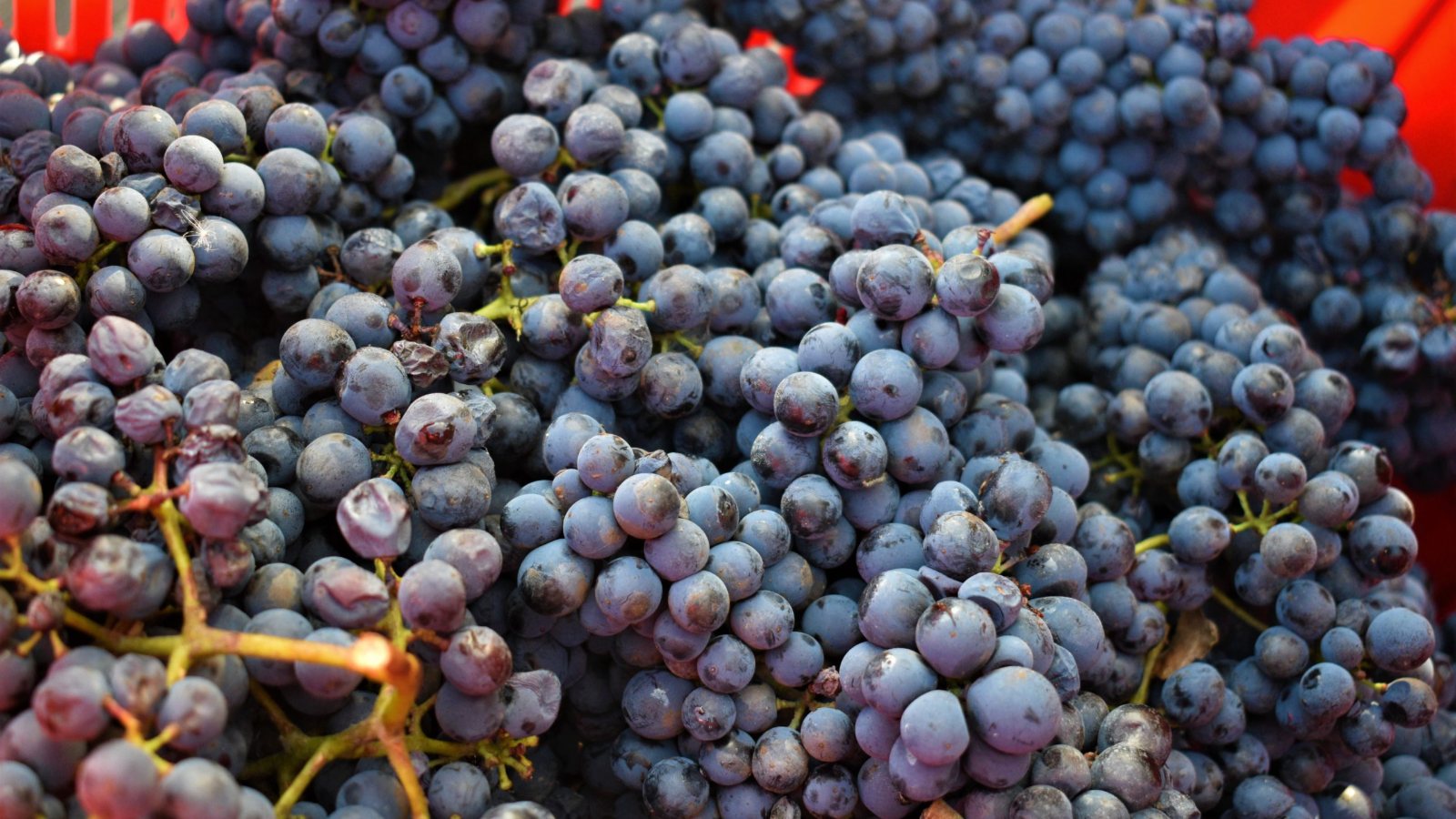
The grape harvest (in Italian, “vendemmia”) is the picking of grapes destined to become wine. In practice it works like this: the grower checks how ripe the grapes are, chooses the right day, picks the bunches by hand or by machine and takes them to the cellar as quickly as possible. There the grapes are destemmed, crushed, pressed and left to ferment. In Italy the harvest usually runs from late August to late October, but the date varies a lot from area to area and from year to year. Below you will find the calendar, each stage one by one, the differences between hand and machine picking and the role of the weather.
In short
- In Italy the harvest usually falls between late August and late October: first white grapes and sparkling wine bases, then reds and late harvests.
- The date is decided by the grapes, not the calendar: sugars, acidity, ripeness of skins and seeds.
- There are five main stages: picking, destemming and crushing, pressing, fermentation, racking with ageing and bottling.
- Picking by hand costs more but lets you choose bunch by bunch; machine picking is faster and only used on flat or gently sloping land.
- Hot years can bring everything forward by as much as two weeks.
Contents
- What the harvest really is
- When the harvest takes place in Italy
- How the right day is chosen
- The stages of the harvest, from vineyard to cellar
- Hand or machine harvesting?
- How the weather changes the harvest
- Working the harvest: hard work and pay
- Our view: you understand the harvest by following the vineyard all year
- A gift for anyone who wants to experience the harvest up close
- Frequently asked questions
- Sources
What the harvest really is
The Italian word comes from the Latin vindemia, from vinum (wine) and demere (to remove, to detach): detaching the grapes from the vine. Today, though, the term means two things. In the narrow sense it is the picking. In the broader sense it is the whole period from the first cuts in the vineyard until the must ferments in the cellar.
It is the moment when a whole year’s work is gathered in. Winter pruning, budburst in spring, flowering, fruit set, veraison in summer: each stage prepares the bunch that reaches the cellar. A mistake at harvest time, such as picking too early or leaving the grapes in the sun in their crates, can ruin months of care.
That is why, for small producers, the harvest is also a ritual. Work starts early, many hands help, often family and friends. And the mood of the year can already be read in the first bunches.
When the harvest takes place in Italy
The typical period, as summarised by the Atlas of Seasons harvest calendar (in Italian), runs from late August to late October. In Chianti the peak usually falls around 25 September, while in cooler areas such as the Langhe the harvest can go on well into October.
There is also a legal framework. Law no. 238 of 12 December 2016, known as the Consolidated Wine Act, sets out in article 10 the period in which grapes may be picked and musts fermented, and the Regions can adjust dates and exemptions: this is explained well on the Veneto Region page on the harvest period (in Italian). The general window runs from 1 August to 31 December.
Within this window the order follows a precise logic:
| Period | What is usually picked | Why |
|---|---|---|
| August, first weeks of September | Grapes for traditional method sparkling wines, early varieties | High acidity and moderate sugars are needed |
| September | Most white grapes and medium-bodied reds | Balance between freshness and ripeness |
| Late September, October | Structured reds and late varieties, cool and mountain areas | Skins and seeds need more time |
| Late October and beyond | Late harvests and grapes for drying | The aim is concentrated sugars and aromas |
The table is a guide, not a timetable. What counts is the grape variety, latitude, altitude, the vineyard’s exposure and the style of wine the producer has in mind. Two vineyards in the same village, one facing south and one facing north, can be harvested days apart.
How the right day is chosen
In the weeks before picking, the grower goes into the vineyard almost every day. Looking, touching, tasting. There are three things they keep an eye on.
Sugars. They are measured on the juice of a few grapes with a refractometer or in a laboratory. More sugar means more potential alcohol in the wine.
Acidity. As sugars rise, acidity falls. A wine without acidity is flat and ages badly. For sparkling wines the grapes are picked while acidity is still high; for a red meant for ageing, it is worth waiting.
Phenolic ripeness. This is the ripening of skins and seeds, which give colour, tannins and many aromas. A seed that is still green gives harsh tannins. It is often judged by eye and by taste: skin that comes away easily, brown crunchy seeds, sweet pulp.
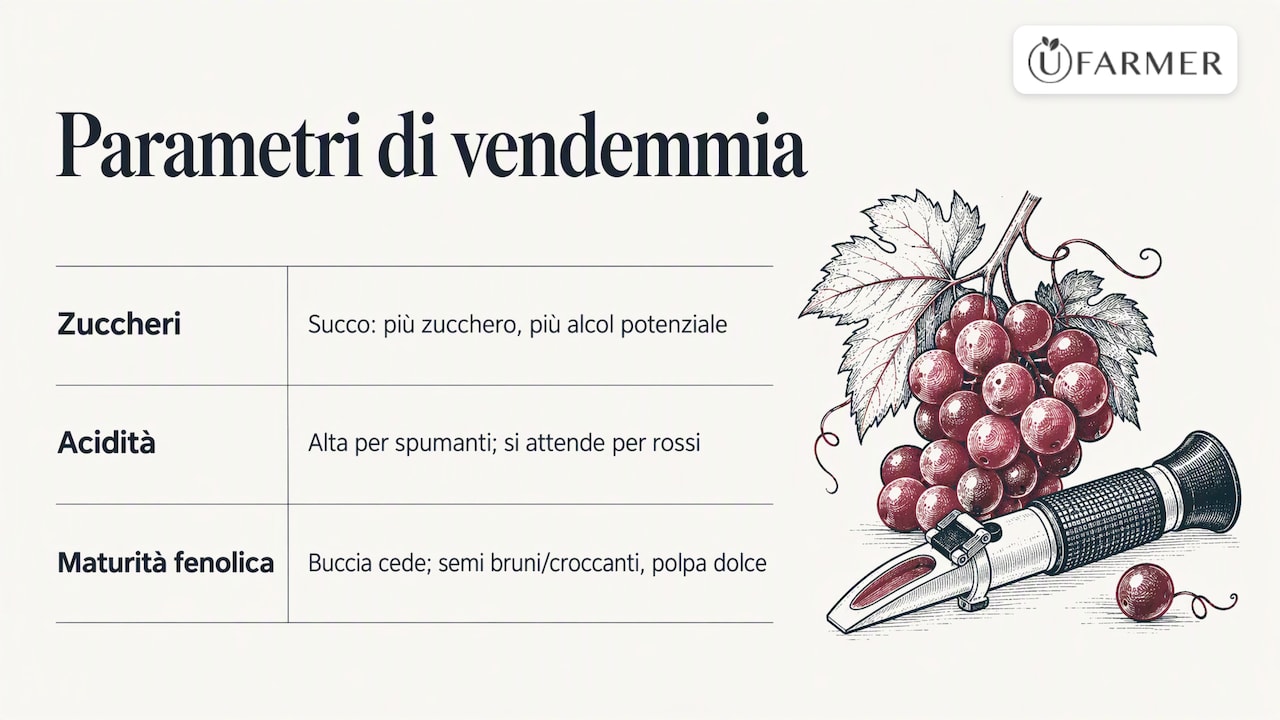
When the three are in balance for the wine they want to make, picking begins. Then the weather has its say: if a heavy storm is on the way, the grower may choose to pick a few days early rather than risk hail or wet, rotting grapes.
A practical detail: picking is best done in the cool morning hours. Warm grapes tend to oxidise and start fermenting too early, which no winemaker wants.
The stages of the harvest, from vineyard to cellar
Here is the grapes’ journey, step by step.
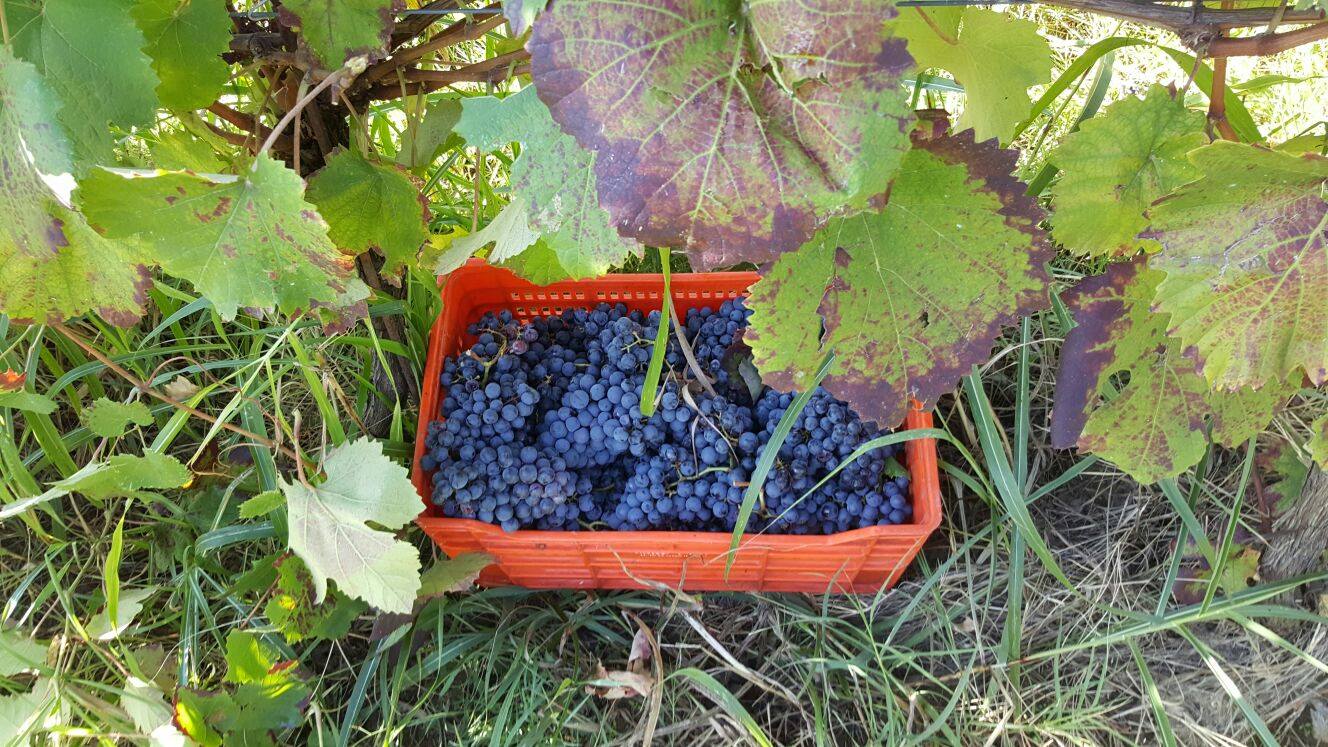
- Picking. By hand, with harvest shears, or with a harvesting machine. Hand-picked bunches go into shallow crates, so the weight does not crush the grapes at the bottom. The crates are taken to the cellar quickly.
- Sorting. Optional but increasingly common among quality producers. On a sorting table, leaves and dry, bruised or mouldy grapes are removed. It can also be done in the vineyard, discarding imperfect bunches as they are cut.
- Destemming and crushing. The destemmer separates the grapes from the stalk, the woody part of the bunch, which would give bitter, green notes. Then the grapes are gently broken to release the juice. The result is the must.
- Pressing. For whites it happens straight away: the must is separated from the skins to make a clear, fresh wine. For reds the must stays in contact with the skins during fermentation (maceration), and that is where colour and tannins come from.
- Alcoholic fermentation. Yeasts turn sugars into alcohol and carbon dioxide. Whites ferment at lower temperatures to preserve aromas, reds at higher temperatures to extract colour from the skins. With reds, the juice is pumped over or the cap is punched down to wet the “cap” of skins that rises to the surface.
- Racking, ageing and bottling. Once fermentation is over, the wine is separated from the pomace. Then it rests in steel, concrete, wood or amphora for weeks, months or years, depending on the style. Finally it is bottled.
The first four stages happen within hours. That is why cellars work non-stop at harvest time: grapes don’t wait.
Hand or machine harvesting?
Hand harvesting is the one everyone imagines: teams of pickers along the rows, shears in hand, crates stacked at the end of each row. Machine harvesting uses machines that straddle the row and shake the vines until the grapes come off, collecting them on belts.
| Criterion | Hand picking | Machine picking |
|---|---|---|
| Speed | Slow, many people needed | Very fast, even at night |
| Cost | Higher | Lower per hectare |
| Selection | Bunch by bunch, immediate discarding | Picks everything, selection comes later |
| Grape integrity | Whole bunch, few breakages | Loose grapes, more free juice and risk of oxidation |
| Terrain | Any slope, even terraces | Only flat or gently sloping land, with suitable vineyard layouts |
| Typical use | Premium wines, traditional method sparkling wines, late harvests, steep hills | Large areas on the plains, everyday wines |
So the choice is not just about cost. In a terraced mountain vineyard or on a steep hill, the machine simply cannot get in. For some wines, such as traditional method sparkling wines or grapes left to dry, whole bunches are needed and hand picking is effectively a must.
Machine harvesting, on the other hand, has real advantages: on a cool night it picks hectares of grapes when the temperature is ideal, and modern machines are much gentler than those of a few decades ago. It is not a “second-rate” method: it is a tool suited to certain vineyards and certain wines.
How the weather changes the harvest
In recent years the weather has become the first topic of every harvest. Hotter summers speed up the ripening of sugars, but not always that of skins and seeds. The risk is very sweet grapes, and so more alcoholic wines, with unripe aromas and little acidity.
As Atlas of Seasons notes, hot years can bring the harvest forward by as much as two weeks. That is why peak dates should be read as a guide, not an appointment.
Growers respond in various ways:
- Canopy management: more leaves are left to shield the bunches from direct sun.
- Cover crops and green manure: grass between the rows and crops dug into the soil hold moisture and protect the soil from stress.
- Picking in stages: the same vineyard is gone through several times, picking only the bunches that are ready.
- Higher vineyards: in many areas growers are looking to higher, cooler slopes.
Rain close to the harvest matters too: it dilutes sugars and encourages mould. Every year tells a different story, and that is exactly what makes one year’s wine different from the year before.
Working the harvest: hard work and pay
Hand harvesting is hard work, there is no getting around it. You spend hours bent over, often on sloping ground, with crates that need moving all the time. You start at dawn and work as long as the heat allows. People who try it for the first time usually mention two things: the backache and the lunch everyone shares at the end of the morning.
As for pay in Italy, the rules depend on the type of contract. For occasional farm work, INPS circular no. 107 of 5 July 2017 (in Italian) set different minimum hourly rates by area (€7.57, €6.94 and €6.52), with daily pay of no less than four hours’ work. This option, however, is reserved for specific groups, such as pensioners, students, the unemployed and people receiving income support. The amounts are those from 2017: before accepting a job, check the current figures and the contract you are offered with a trade union advice centre, a tax assistance centre or an employment consultant.
Our view: you understand the harvest by following the vineyard all year
We work every day with small selected Italian producers, and we have learned one thing: you don’t understand the harvest by looking only at the picking days. You understand it by following the vineyard for a whole season.
If you have seen the winter pruning, the first buds, the flowering and the veraison, you reach September already knowing what to expect. You understand why a rainy year gives a different wine from a dry one. You understand why the producer brought the harvest forward or put it off. And when you open the bottle, that wine has an extra flavour.
That is the idea we started from. With more than 5,000 adoptions begun and more than 30 Italian producers, every year we see how much it means to people to feel part of the cycle, not just receive a finished product. That is exactly what the seasonal updates are for: telling the story of the vineyard as it grows, at its own pace, without shortcuts.
For us it is also a matter of respect. The harvest is made of choices, risks and hard work that usually stay invisible. Telling that story, from the vineyard to the bottle, is the most honest way to value the work of the people who really make the wine.
A gift for anyone who wants to experience the harvest up close
If you know someone who loves wine and is not satisfied with just any bottle, you can give them a vineyard. With a vineyard adoption, from €85, you choose an Italian producer, follow the vineyard through seasonal updates and receive the wine according to the adoption calendar. The adoption certificate with your message arrives straight away by email, even on the very day you give the gift.
You can make the gift even more personal, for an extra charge, with vinyl lettering, a wooden tag or a personal label. If you prefer olive oil, there is the olive tree adoption, from €69. To taste before deciding, there are our tasting boxes: they are the only option that arrives by Christmas, for orders placed by 17 December. Every step is explained on the page about how adoption works.

Frequently asked questions
What happens during the harvest?
Ripe bunches are picked, by hand or by machine, and taken straight to the cellar. There the grapes are separated from the stalks, crushed and, for whites, pressed. Then the must ferments and becomes wine. The first stages are packed into a few hours so the grapes don’t warm up or oxidise.
How long does the harvest last?
In a single small vineyard a few days may be enough. A producer with several grape varieties and vineyards, on the other hand, harvests in stages over weeks, from the early grapes of late August to the reds of October. Late harvests go on even longer.
Is the harvest really hard work?
Hand harvesting is: you work bent over for hours, often on slopes, moving full crates. You start early to make the most of the cool morning. Many people still remember it as a lovely experience, full of teamwork and long tables at the end of the day.
Why are grapes still picked by hand in some areas?
Because machines cannot work on steep hills and terraces. And because the finest wines, traditional method sparkling wines and grapes for drying need whole bunches, selected one by one.
Sources
- Atlas of Seasons: the harvest calendar in Italy (in Italian)
- Veneto Region: harvest period (in Italian)
- INPS: circular no. 107 of 5 July 2017 (in Italian)