


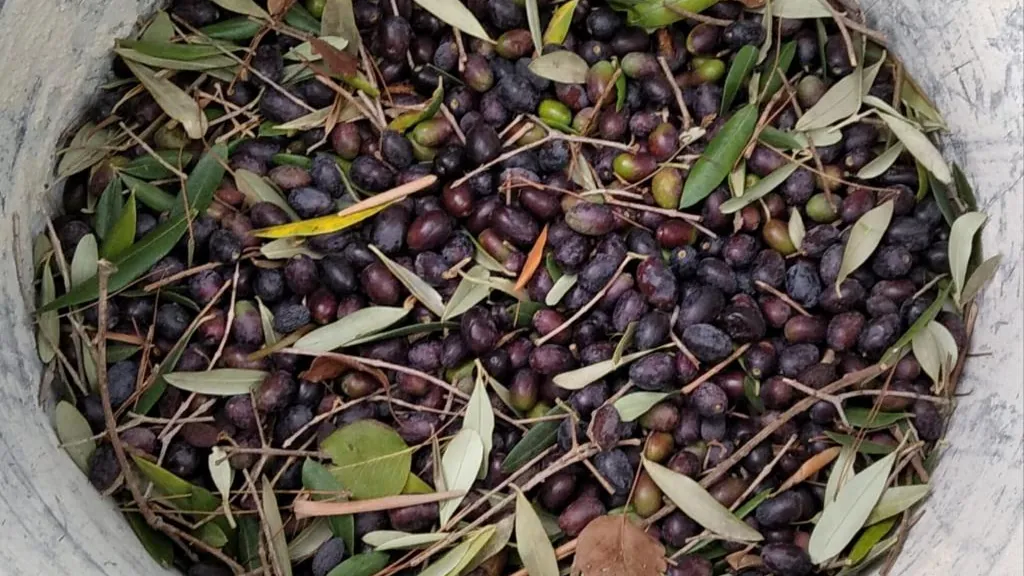
In Italy, olives are usually harvested between late September and January. For oil olives the best moment is veraison (in Italian, invaiatura), the stage when the skin turns from green to purplish red. According to L’Informatore Agrario, this stage falls between mid October and mid December, depending on the area and the variety. So there is no single date that works for everyone. The cultivar matters, the weather of the year matters, and so does the kind of oil the producer wants to make. In this guide you will find the calendar by area, the signs to look for on the tree and what changes in the oil if the olives are picked early or late.
In brief
- The season: in Italy the harvest runs from late September to January. The peak falls between October and November.
- The ideal moment for oil is veraison: the skin turns from green to the purplish red typical of the variety.
- Every year is different: variety, heat and water availability shift the date. In 2026 the heat brought ripening forward in many areas.
- The earlier you pick, the greener, more bitter and more pungent the oil. The longer you wait, the softer and riper it is, but beyond a certain point quality drops.
- After the harvest the olives must be processed quickly, within 24 hours, so as not to lose quality.
Contents
- The olive harvest season in Italy
- Why the date changes every year
- How to tell if the olives are ready to pick
- Green, veraison or ripe: what changes in the oil
- What happens if the olives are not harvested
- From the tree to the mill: why time matters
- Our view: the harvest is a choice, not a date
- Following the harvest from home by adopting an olive tree
- Frequently asked questions
- Sources
The olive harvest season in Italy
The season opens at the start of autumn and closes in the middle of winter. In the South and on the islands some varieties are ready as early as late September. In other areas, especially for oil olives from late cultivars, it runs into January. Most of the work is concentrated between October and November.
The timing also depends on what you want to make. Green table olives are picked first. Oil olives are picked when the balance between yield and quality is at its best. Those destined to become black table olives are left to ripen longer.
For concrete reference points it helps to look at the production rules of the PDO oils. These are the official regulations that set the production rules for a designation-of-origin oil, including the harvest windows. Here are a few examples from North to South.
| Area, variety or designation | When it is harvested |
|---|---|
| Nocellara del Belice (Sicily) | From late September to mid November, depending on the use: table or oil |
| Grossa di Gerace (Calabria) | Early October, the optimal period indicated by a 2019 study |
| Ottobratica and Sinopolese (Calabria) | The last two weeks of October, according to the same study |
| PDO Terra d’Otranto (Lecce) | By 15 November, under the new production rules |
| PDO Valli Trapanesi (Sicily) | At semi-veraison, no later than 30 December |
| PDO Monti Iblei (Sicily) | Deadline between 30 October and 15 January, depending on the geographical mention |
| Oliva Aitana dei Colli Tifatini (Caserta) | In stages between November and January |
| Toscano PGI | In the period set each year by the Consortium |
A few details on the sources behind the table. The Nocellara periods are those reported by the Sicilian Region on the Belice Valley. The Calabrian dates come from a study on Calabrian cultivars published in 2019. For Terra d’Otranto, the new production rules set the deadline at 15 November: previously it was 31 January. The Valli Trapanesi rule is in the production rules published by the Ministry. The Monti Iblei dates are given by the Monti Iblei protection consortium. For the Aitana the source is the Slow Food Presidium profile. Finally, the Toscano PGI production rules set no dates: they leave it to the Consortium to establish the period for each season.
The last case is the most instructive. Even a major designation prefers to decide year by year, because a fixed calendar is no longer enough.
Why the date changes every year
If you ask ten olive growers when they harvest, you will get ten different answers. It is not confusion: there really are a lot of variables.
The variety
Each cultivar has its own timing. There are early varieties, which reach veraison at the very start of autumn, and late varieties, which stay green well into November. In the same grove, with several cultivars, the harvest can last for weeks.
The weather of the year
Heat and drought speed up ripening, a cool autumn slows it down. The 2026 plant health bulletin of the Tuscany Region notes that climate change has brought ripening forward compared with historical averages. For this reason it advises assessing the olives field by field, taking into account variety, fruit load and water availability.
In 2026 the effect was clear to see. In early October Il Tirreno wrote that in many parts of Tuscany the olives had already been ready for harvesting and milling for a couple of weeks. On the eve of the season, Federolio estimated for Italy a production drop of around 20%, with good prospects for quality.
The forecast for the decisive days
Short-term forecasts count too. According to the Rivista di Agraria, if bad weather or a risk of fruit drop is forecast, it is better to bring the harvest forward rather than delay it, to limit losses.
How the farm is organised
Then there is a very practical factor. The same magazine explains that a highly mechanised farm can concentrate the harvest in the optimal moment. Those who take many days to harvest, on the other hand, do well to start earlier, so the last trees do not end up too ripe.
How to tell if the olives are ready to pick
You do not need a laboratory to get an idea. Here are the signs a producer looks for, from the simplest to the most technical.
- The colour of the skin. This is the first indicator. When a good share of the olives turns from bright green to yellowish green and then to purplish red, veraison is under way. The final colour varies from variety to variety: some stay light for a long time.
- The colour of the flesh. Cut an olive open. If the flesh is still entirely pale green, the fruit is behind. If the dark colour of the skin is starting to spread into the flesh, ripening is well advanced.
- Resistance to detachment. As they ripen, the fruits come away from the twig more easily. Those who harvest by machine measure this force with a dynamometer. The Rivista di Agraria gives values below 4 or 5 Newtons as optimal.
- The firmness of the flesh. The riper the olive, the softer it becomes. A penetrometer measures how much resistance the flesh offers. According to Vita in Campagna, dropping below 250 g/mm² increases the risk of crushing and means storage before pressing must be shortened.
- Olives on the ground. If many fallen olives appear under the tree, natural fruit drop has begun. It is a sign not to be ignored: every day of waiting has a cost.
A practical tip: look at several trees and several sides of the canopy. Olives exposed to the sun ripen before those inside the canopy or on the shaded side. A sample taken from a single tree can be misleading.
Green, veraison or ripe: what changes in the oil
The moment of harvest shapes the character of an extra virgin oil more than you might think. Here are the three main stages, as described by L’Informatore Agrario.
| Moment of harvest | What the oil is like | What to consider |
|---|---|---|
| Early, olives still green | Green fruitiness, vegetal aromas, pronounced bitterness and pungency | Lower oil yield |
| Veraison | The best balance between aromas, quality and yield | This is the stage indicated as ideal for oil |
| Advanced ripening | Ripe fruitiness, little bitterness and pungency, aromas of ripe fruit | Softer oil, but less complex |
| Late | Sharp drop in quality | The yield only seems higher because the olives lose water |
The last row deserves an explanation. Waiting too long can give a small increase in the oil inside the fruit. Or it can raise the apparent yield, because the olives dehydrate and weigh less. In both cases the price is a serious drop in quality.
The industry’s approach has changed too. The International Olive Council notes that in the past the main aim was maximum oil yield. Today the preference is to balance early harvesting and oil content, to obtain the best quality.
For those who taste, this comes down to a simple rule. A very bitter and pungent oil is not faulty: it usually comes from olives picked early, rich in phenolic compounds. A sweet, rounded oil, on the other hand, often comes from riper olives.
What happens if the olives are not harvested
If the olives stay on the tree past the right moment, at some point they start to fall on their own. This is natural fruit drop. Part of the crop ends up on the ground and is lost, and the quantity that can still be harvested shrinks, as L’Informatore Agrario points out.
Fallen olives are not suitable for a quality oil. They stay in contact with the soil, get bruised and deteriorate quickly. Even those left on the tree, overripe, give a less fragrant oil. That is why producers prefer being slightly early to being late.
From the tree to the mill: why time matters
The harvest does not end when the olive leaves the branch. From that moment a countdown begins. The Tuscany Region bulletin recommends processing the olives within 24 hours of harvesting. For olives that are damaged or affected by the olive fruit fly, the window shrinks to a few hours.
What careful producers do to respect these timings:
- They harvest by hand or with harvesting aids, the comb-like or vibrating tools that shake the branches, onto nets spread under the canopy, so the olives never touch the ground.
- They use low, perforated crates, which let the air circulate and stop the fruits from crushing one another.
- They keep the olives cool and in the shade while waiting for milling, never in closed sacks or in the sun.
- They separate the healthy olives from those that have fallen or are damaged.
These are simple gestures, but they make the difference between a good oil and an excellent one. The same careful work in the field begins months earlier, with the flowering and fruit set we describe in our guide to olive trees in spring.
Our view: the harvest is a choice, not a date
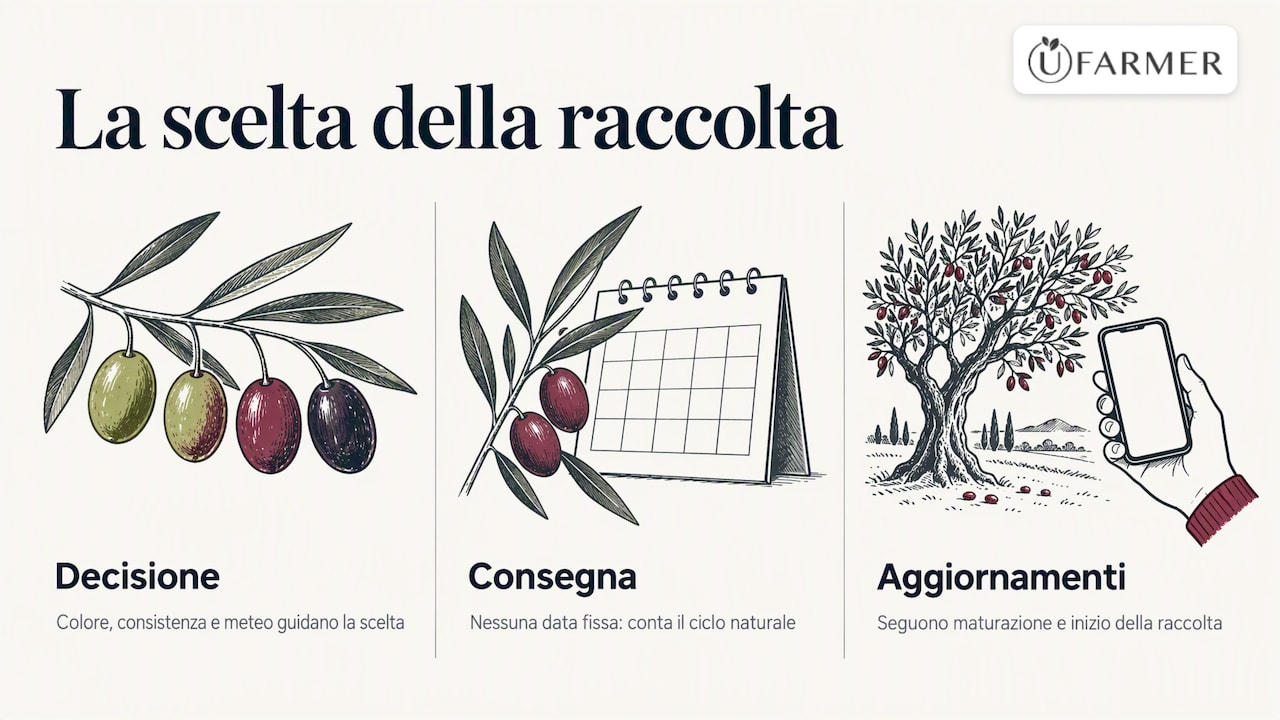
We work every day with small Italian olive oil producers, and one thing we have learnt: the harvest is the most important decision of the year. The calendar does not make it. The producer and their tree make it, by looking at colour, firmness and weather.
That is why we never promise fixed delivery dates for the oil. Wine and oil arrive according to the adoption calendar, that is, when the natural cycle has come to an end and the product is ready. Bringing it forward out of haste or delaying it for convenience would mean giving up the quality you are looking for.
Those who adopt an olive tree experience the season up close. The producer’s updates tell you how ripening is progressing and when the harvest begins. That way you understand why your oil has that aroma and that character. Every producer we select has their own style: you can get to know them on our page about Italian olive oil producers.
We believe that knowing how an oil comes to be makes it taste better. And makes it an even finer gift.
Following the harvest from home by adopting an olive tree
If the olive season intrigues you, you can experience it without owning a grove. With UFarmer you can adopt an olive tree from a selected small Italian producer, from 69 €. Here is what you receive:
- The adoption certificate with a dedication, which arrives straight away by email or on the day you choose. It is perfect if it is a gift.
- Updates from the producer throughout the season, right up to the harvest.
- Your extra virgin olive oil at home, at the end of the natural cycle, according to the adoption calendar.
You can personalise the packaging, for a fee, with vinyl lettering, a wooden tag or a personal label, even after purchase. Among the current offers you will find the Fratelli Bonanno olive tree with Biancolilla IGP, the extra virgin olive oil from Il Merlo and the IGP extra virgin olive oil from Villa Petriolo. All the options are on the olive tree adoptions page, and if you want to understand the steps you will find everything in how adoption works.
Looking for something to put under the tree? Only the tasting boxes can arrive in time for Christmas, for orders placed by 17 December. An adoption, on the other hand, is given as a gift with the certificate, which arrives straight away by email. You will find more ideas among our Christmas gifts.

Frequently asked questions
When is the best time to harvest olives for oil?
The best moment is veraison, when the skin turns from green to the purplish red typical of the variety. In many parts of Italy it falls between mid October and mid December. At that stage the oil has the best balance between aromas, quality and yield. Harvesting much earlier gives a more bitter and pungent oil, with a lower yield.
Can olives be harvested in September?
Yes, for some varieties and uses. Nocellara del Belice, for example, starts to be picked in late September, mainly for the table. In hot years, such as 2026, some oil olives were also ready earlier than usual. For most oil cultivars, however, September is still early.
How long can pass between harvest and milling?
Technical guidance recommends processing the olives within 24 hours of harvesting. For olives that are damaged or affected by the olive fruit fly, the margin drops to a few hours. While waiting, they should be kept in perforated crates, cool and in the shade.
Do early-harvested olives make better oil?
They make a different oil: greener, more herbaceous, more bitter and pungent, rich in phenolic compounds. Many consider it of great quality, but the yield is lower. Riper olives give a sweeter, softer oil. Beyond a certain point of ripeness, however, quality drops sharply.
When does the oil from an adopted olive tree arrive?
The oil arrives according to the adoption calendar, that is, after harvesting and processing, when the product is ready. It does not depend on a fixed date but on the natural cycle of the tree. The certificate with a dedication, on the other hand, arrives straight away by email or on the day you choose.
Sources
- L’Informatore Agrario: the best time to harvest olives (in Italian)
- Sicilian Region: the Belice Valley and Nocellara (in Italian)
- Study on Calabrian cultivars (European Journal of Lipid Science and Technology, 2019)
- Olivo e Olio: new production rules for PDO Terra d’Otranto (in Italian)
- MASAF: PDO Valli Trapanesi production rules (in Italian)
- Monti Iblei protection consortium (in Italian)
- Slow Food Foundation: Oliva Aitana dei Colli Tifatini (in Italian)
- Tuscany Region: Toscano PGI production rules (in Italian)
- Tuscany Region: advice on harvesting and storage 2026 (in Italian)
- Il Tirreno: the Tuscan olive oil harvest in 2026 (in Italian)
- Tasting Life: the Federolio estimates for 2026 (in Italian)
- Rivista di Agraria: the optimal olive harvest period (in Italian)
- Vita in Campagna: measuring and deciding the harvest (in Italian)
- International Olive Council: olive ripening