


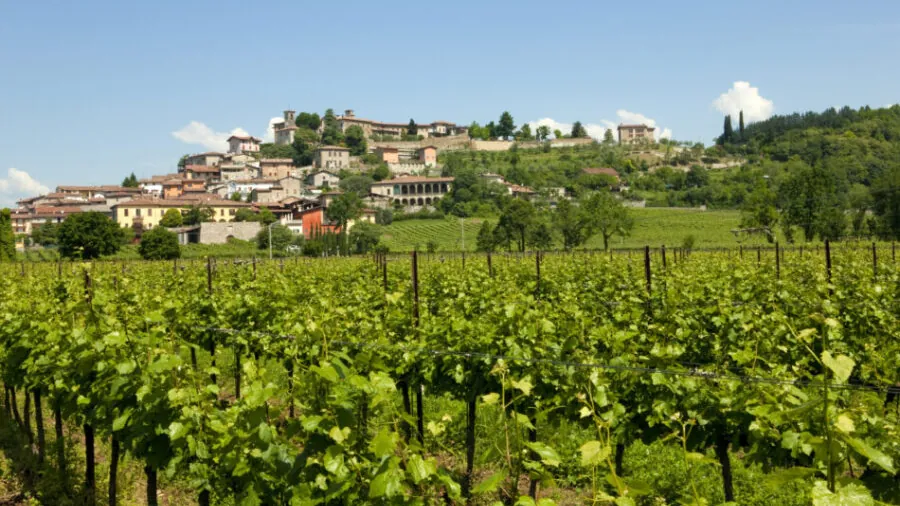
In spring the vineyard moves from its winter rest into the most delicate season of the year. Within a few months the vine “bleeds” from its pruning cuts, opens its buds, puts out its first leaves and reaches flowering, which determines how many grapes there will be in September. In this guide you will find the stages in the order you see them along a row, the months in which they usually happen in Italy, the work the winegrower does in the field and the risks that keep them awake at night. And if you have adopted a vineyard, or are thinking of giving one as a gift, find out what the season’s updates tell you.
In brief
- The vine’s spring always follows the same order: bleeding, bud break, shoot development, flowering and fruit set.
- Bud break in Italy usually falls between late March and April: in the Prosecco DOC area, in 2024, it was recorded on 28 March.
- Flowering comes between late May and early June and is the stage that determines the quantity of grapes.
- The main jobs are tying down, sucker removal, shoot thinning, trellising, managing the grass between the rows and protecting against fungal diseases.
- The enemies of the season are late frosts on newly emerged shoots, and downy mildew and powdery mildew when humidity and warmth arrive.
Contents
- From winter dormancy to awakening
- Bleeding of the vine: the first sign
- Bud break: when and how it happens
- From shoots to flowering, stage by stage
- Vineyard work in spring
- Late frosts, the April risk
- What you see when you adopt a vineyard
- Our point of view
- A gift that starts in a vineyard row
- Frequently asked questions
- Sources
From winter dormancy to awakening
To understand the vineyard in spring you have to start from winter. After the grape harvest and leaf fall, the vine enters dormancy: the buds formed during the summer stay closed and protected by their scales, waiting for the right moment. It is a defence mechanism. Dormancy is the process that stops the buds from sprouting in the same season in which they formed, so the plant does not waste energy and does not expose tender tissue to the cold.
To come out of this rest the vine needs two things, in sequence:
- A period of winter cold, which “recharges” the buds and gets them ready to start again.
- A stable rise in temperatures, together with longer days, which gives the signal to start.
That is why spring in the vineyard has no fixed date on the calendar. A mild winter or a very warm March can bring everything forward by weeks, while a cold, rainy spring slows the restart. It is no coincidence that agronomic research is closely following the effect of warmer winters on dormancy in deciduous fruit plants, vines included: waking up too early exposes the plant to the last blows of winter.
Bleeding of the vine: the first sign
The first sign that the vineyard is waking up is not green, it is a drop. When the soil warms up, the roots start working again and push water and mineral salts upwards. From the still-fresh cuts of winter pruning, a clear sap then seeps out and drips from the canes: this is the bleeding of the vine.
For those who work in the vineyard it is good news. It means that:
- the roots are active and the plant has survived the winter;
- the sap is circulating again and the buds are about to swell;
- pruning has been done, or needs to be finished quickly.
Bleeding lasts a few days or a few weeks, depending on the plant and the weather, and then stops on its own when the cuts heal over. It does not harm the vine. It is also the moment when many winegrowers complete the tying down: the fruiting canes left after pruning are bent and fixed to the wires, because the wood is now more flexible and breaks less easily.
Bud break: when and how it happens
Bud break is the moment everyone waits for. The buds swell, the protective scales open and a small woolly tip appears, whitish at first and then pinkish. Within a few days the first tiny leaves emerge from that tip, opening one after another along the new shoot.
When does the vine break bud
In Italy bud break usually takes place between late March and April, with sometimes wide differences between North and South, between plains and hills, and from one grape variety to another. A concrete reference comes from the field data of the Prosecco DOC Consortium, which records the stages in the vineyard every year: in 2024 bud break was recorded on 28 March, flowering on 30 May and the harvest on 15 September.
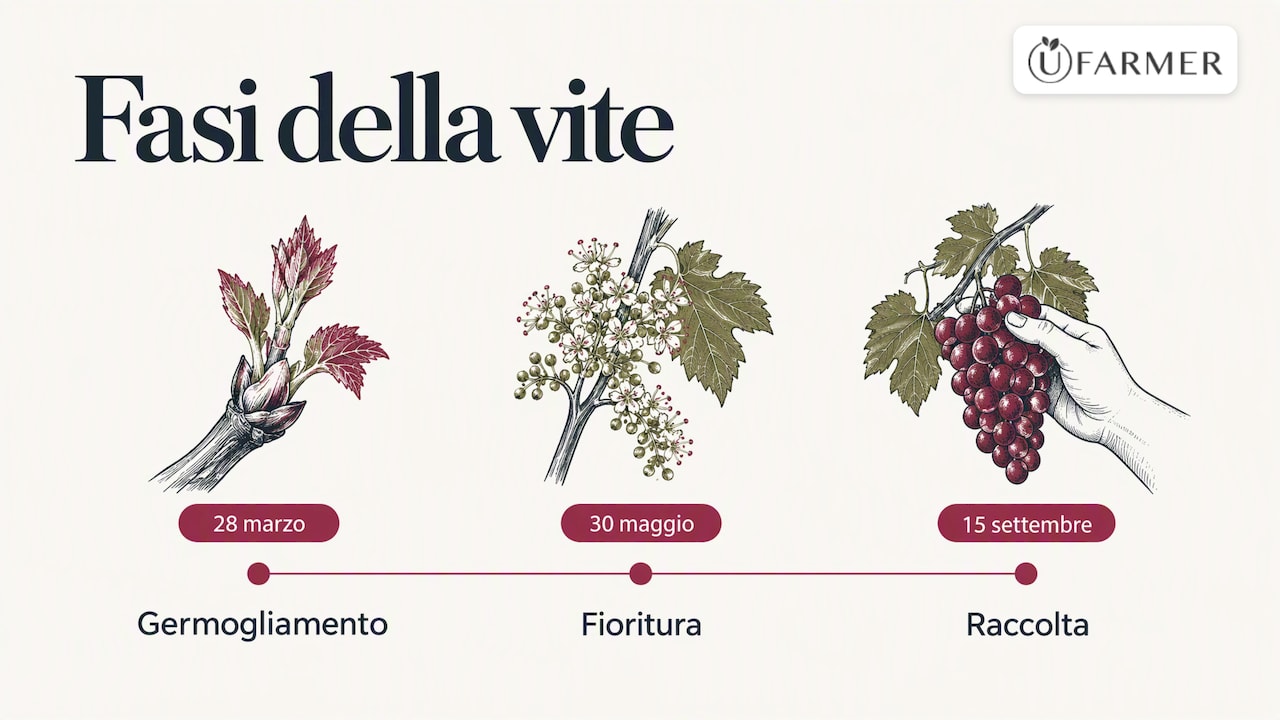
These figures apply to that area and that vintage. In a mountain vineyard or in a cooler area the dates shift later, while in the warmer regions of the South the vine can start earlier.
What changes the date
There are four main variables:
- The grape variety: there are early varieties, which break bud soon, and late varieties, which start later and are less at risk from frost.
- The area and the altitude: in the hills and mountains spring arrives later than on the plains or near the sea.
- The exposure: a south-facing row warms up before a north-facing one.
- The course of winter and March: this is the factor that changes most from one year to the next.
On the same plant, moreover, not all the buds start together. As a rule, those at the tip of the cane open first, followed by those closer to the trunk.
From shoots to flowering, stage by stage
After bud break, growth speeds up. The shoots lengthen, the leaves unfold and, just a few weeks after the start, the inflorescences appear among the leaves: tiny clusters of closed green flower buds, which will become the grapes of the harvest. The table summarises the main stages in the order you see them.
| Stage | What you see in the vineyard | Indicative period in Italy |
|---|---|---|
| Bleeding | Drops of sap from the pruning cuts | Late winter, early spring |
| Bud break | Swollen buds, woolly tip, first tiny leaves | Late March, April |
| Shoot development | Green shoots lengthening, leaves unfolding | April, May |
| Inflorescences visible | Small clusters of closed flower buds | May |
| Flowering | Flower buds shedding their caps, stamens visible | Late May, early June |
| Fruit set | Fertilised flowers become tiny berries | June |
The periods are indicative and vary a great deal with the area and the vintage. Take them as a map, not as a calendar.
Flowering, the most delicate moment
The vine flower is small, green and inconspicuous: no coloured petals, just a cap that comes away and reveals the stamens. It almost goes unnoticed, but a vineyard in flower has a light, sweet scent that those who work there recognise straight away.
In Italy flowering takes place between late May and early June, with significant variations from one year to the next linked to the season’s climate. It is the transition to the reproductive phase, and this is why it is the time when the winegrower looks at the sky most often: persistent rain, strong wind or cold during flowering can reduce fertilisation and leave loose bunches, that is, bunches with fewer berries.
Fruit set
When the flowers are fertilised, the ovary swells and becomes a tiny, hard, green berry. This is fruit set: from here on the winegrower has a clearer idea of how many grapes there will be. Some of the flowers always drop naturally, and that is normal. With fruit set the vineyard’s spring comes to a close and summer begins, the season when the berries grow and, later on, of veraison (in Italian, invaiatura).
Vineyard work in spring
Spring is the busiest season for those who work between the rows. Every job has a precise purpose: to help the plant focus its energy on the right bunches and to keep the canopy healthy and well aired. Here are the main jobs, in the order in which they are usually done.
- Finishing pruning and tying down: the last cuts are made and the canes that will carry the grapes are fixed to the wires.
- Sucker removal: the suckers are removed, the shoots that grow from the trunk or the base of the plant. They do not produce quality grapes and they take energy away.
- Shoot thinning: double or excess shoots are removed, leaving only the well-positioned ones. This regulates production and lets air into the canopy.
- Trellising: as the shoots grow, they are gathered and guided between the wires, often by raising the movable wires, so that the vegetation grows neatly upwards.
- Soil management: between the rows a choice is made between leaving the grass (cover crop), working the soil or sowing plants to be dug in.
- Disease protection: treatments are carried out to protect leaves and inflorescences from fungi, depending on the weather.
Grass between the rows and green manure
In many vineyards spring is also the season of flowers between the rows. Cover cropping, that is, letting a grassy cover grow or sowing one between the rows, protects the soil from erosion, attracts beneficial insects and keeps organic matter in the soil. Some producers choose green manure: they sow species such as legumes and grasses and then dig them in. It is an ancient technique that increases soil fertility and counters its lack of organic matter.
Protecting against downy mildew and powdery mildew
Spring also brings fungal diseases. The two most feared are downy mildew, which loves rain and humidity, and powdery mildew, which develops in warm weather. Both attack leaves and inflorescences and, if neglected, can compromise the harvest.
There is no treatment calendar that is the same for everyone. Technical guidelines for viticulture, such as the Viticoltura 2026 manual from the Fondazione Edmund Mach, are built around agronomic management and the containment of pests and diseases, with up-to-date guidance on permitted products. In practice, protection adapts to the weather: many estates use local weather stations to intervene only when the risk is real, protecting the harvest without unnecessary treatments. A very rainy year changes everything: in France, for example, the plant health report for Lorraine recorded very strong downy mildew pressure for 2024, driven by abundant rainfall and humidity.
If you grow a few vines in your garden, do not copy a calendar found online: the products you can use and the doses change with the regulations and with the area. Ask the technician at your local agricultural cooperative or your region’s plant health service before treating.
Late frosts, the April risk
A newly emerged shoot is tender and full of water. A clear April night with the temperature dropping below zero can burn it in a few hours: the tiny leaves blacken and the main bud is lost. The vine can start again from its reserve buds, but with fewer and less fertile bunches.
Spring frosts are a serious threat to fruit crops in temperate areas. A systematic review of strategies against spring frosts compared the effectiveness and limitations of the protection methods used in orchards and reminds us that damaging events cannot be ruled out in the future. In vineyards, several strategies are used:
- pruning later, to delay bud break by a few days;
- choosing late bud-breaking varieties in areas at risk;
- keeping the grass short between the rows on cold nights, because bare, compact soil gives off more heat;
- in the most exposed cases, fans or anti-frost irrigation.
That is why, when a producer describes a “quiet” spring, they are sharing good news for the year’s wine.
What you see when you adopt a vineyard
Following a vineyard from afar makes all of this tangible. When you adopt a vineyard with UFarmer, you receive updates from the producer during the season: spring is when they tell you about the rows waking up, the first shoots, the work in the field and how the weather is going. Then come summer, the grape harvest and ageing in the winery, right up to the wine you receive at home according to the adoption calendar.
If you want to understand step by step what happens after your purchase, you will find everything on the page about how adoption works. If instead you are more curious about oil, the olive tree’s season runs to a different timetable: we talk about it in the guide to the olive tree in spring, between awakening and flowering.
Our point of view
We work every day with small Italian wineries, and spring is the season that helps us understand best what a wine really means. On the label you read the name, the denomination, the vintage. What you do not read is how many mornings in April the winegrower walked between the rows to check the shoots after a cold night, or how many times they looked at the forecast during flowering.
This is why we believe that adopting a vineyard makes sense above all if you follow it. You do not need to be an expert: it is enough to know that bleeding is a good sign, that the inflorescences in May are the first promise of the harvest and that a spring without frost is already half the vintage saved. With these keys, the producer’s updates stop being simple photos and become a story you know. And when the bottle arrives, the fruit of a year’s work, you know where it comes from.
There is also a practical aspect we care about: the vineyard has its own timing. The wine arrives when the natural cycle is complete, not before. Whoever gives an adoption as a gift also gives the wait, and in our view that is exactly the most beautiful part.
A gift that starts in a vineyard row
If you like the idea of following a vineyard from spring to the grape harvest, you can adopt a vineyard from 85 €. The adoption certificate with a dedication arrives straight away by email, or on the day you choose if it is a gift: perfect for Christmas too, to let the recipient start a season to follow. Bottles and packaging can be personalised for a fee with vinyl lettering, a wooden tag or a personal label, even after purchase. Prefer oil? An olive tree to adopt starts from 69 €.
If you want to let someone taste a winery’s work straight away, the tasting boxes are the only option that can arrive in time for Christmas, for orders placed by 17 December. You will find all the ideas on the Christmas gifts page.

Frequently asked questions
In which month does the vine break bud?
In Italy the vine usually breaks bud between late March and April. The date changes with the area, the altitude, the grape variety and the course of the winter. In the Prosecco DOC area, for example, bud break was recorded on 28 March in 2024.
When does the vine start flowering?
Flowering generally takes place between late May and early June, about two months after bud break. It lasts a few days for each plant and is very sensitive to rain, wind and cold, which can reduce the number of berries.
In which month are vines planted?
New vines are usually planted in late winter or early spring, when the ground is not frozen and the plant is still dormant. Rooted cuttings are used, that is, young plants that have already been rooted and grafted. For a real planting, even a small one, it is worth consulting an agronomist to choose a rootstock and grape variety suited to your soil.
Is there a fixed treatment calendar for vineyards?
No. Protection against downy mildew and powdery mildew is decided on the basis of the weather, the plant’s stage and the disease pressure in the area. Permitted products change over time, so for your own vines refer to the bulletins and technicians of your regional plant health service.
What do you see in an adopted vineyard during spring?
The producer’s updates tell the story of the vineyard waking up, the work between the rows and how the season is going. The wine then arrives according to the adoption calendar, at the end of the natural cycle.
Sources
- Consorzio Prosecco DOC: 2024 performance of the denomination (in Italian)
- Fondazione Edmund Mach: Viticoltura 2026 (in Italian)
- Uva da Tavola: dormancy, the factors that influence it (in Italian)
- Cherry Times: dormancy in fruit trees and climate change (in Italian)
- Cronaca Torino: the return of green manure (in Italian)
- DRAAF Grand Est: 2024 vineyard report (in French)
- PMC: strategies against spring frosts in orchards