



In Italy corporate gifts are tax deductible, but the rule changes depending on who receives them and how much they are worth. A gift to a client with a unit value of up to €50 is deductible in full. Above that threshold it becomes a representation expense and is deductible within a cap calculated on revenue. Gifts to employees, on the other hand, follow the rules for labour costs. Since 2025, in addition, a traceable payment has been required. Here you will find the thresholds, a worked example, VAT and the documents to keep, with the source of every figure.
In short
- Clients, up to €50: the gift is 100% deductible in the year in which you incur the expense. The value is measured on the gift as a whole, not on the individual items in it.
- Clients, over €50: it is a representation expense and is deductible within the cap of 1.5% of revenue up to €10 million, with lower percentages above that. The part that exceeds the cap is lost.
- Employees: for the company the cost is deductible as an expense for work performed. For the employee the fringe benefit threshold applies, €1,000 or €2,000 with dependent children for the three years 2025-2027.
- VAT: on gifts to clients it is deductible only if the unit cost does not exceed €50 and the item is not part of the company’s own business.
- Payment: bank transfer, card or another traceable method. Without it, the deduction is lost.
Contents
- Gifts to clients: the €50 threshold
- Over €50: the cap on representation expenses
- Professionals: the limit of 1% of fees
- Gifts to employees: a different set of rules
- VAT on gifts to clients
- Traceable payment: compulsory since 2025
- The documents to keep
- Our point of view
- A gift for clients and staff that arrives all year round
- Frequently asked questions
- Sources
Gifts to clients: the €50 threshold
Under Italian tax law, gifts to clients, suppliers and business partners are representation expenses (spese di rappresentanza). The rules are in Article 108, paragraph 2, of the TUIR, the Italian income tax code, and in the decree of the Ministry of Economy of 19 November 2008, which treats as business-related the free provision of goods and services made for promotional or public relations purposes and consistent with the commercial practices of the sector.
Within this category, however, there is a fast lane. Goods given away free of charge with a unit value of no more than €50 are deductible in full, without using up the cap. Three details make the difference in practice.
The value is calculated on the whole gift
If you give a gift set with several products, the €50 threshold is measured on the set, not on the single item. As the Fiscomania guide explains, the rule prevents the limit being bypassed by buying the goods separately and then packing them together. A €65 hamper made up of five €13 products is still a €65 gift.
The same reasoning applies to extras: if you pay to personalise a gift, take that cost into account too when you check the threshold with your accountant.
It applies only to goods, not to services
In Circular 34/E of 13 July 2009 the Italian Revenue Agency specifies that full deductibility up to €50 concerns goods only. Expenses for services offered free of charge, such as an experience or an event, stay within the general regime for representation expenses, with the percentage limits.
Goods produced by the company
If you give something you produce yourself, Resolution 27/E of 2014 states that the threshold is measured on the normal value of the item (Article 9 TUIR), not on the production cost. If the normal value exceeds €50, it is the production cost actually incurred that counts towards the cap.
Over €50: the cap on representation expenses
When the gift is worth more than €50, the expense is deductible in the year in which you incur it, but only up to a maximum linked to revenue from core operations. The calculation works in bands, as summarised in the Fiscomania guide to gifts, VAT and IRAP:
| Revenue and income from core operations | Deductible percentage |
|---|---|
| Up to €10 million | 1.5% |
| Part exceeding €10 million and up to €50 million | 0.6% |
| Part exceeding €50 million | 0.4% |
The percentages are added up across the respective bands. The part that exceeds the cap is not deductible and cannot be carried forward to later years: Circular 34/E of 2009 makes this clear. That is why it is worth doing the sums before ordering, not at the end of the year.
Two worked examples
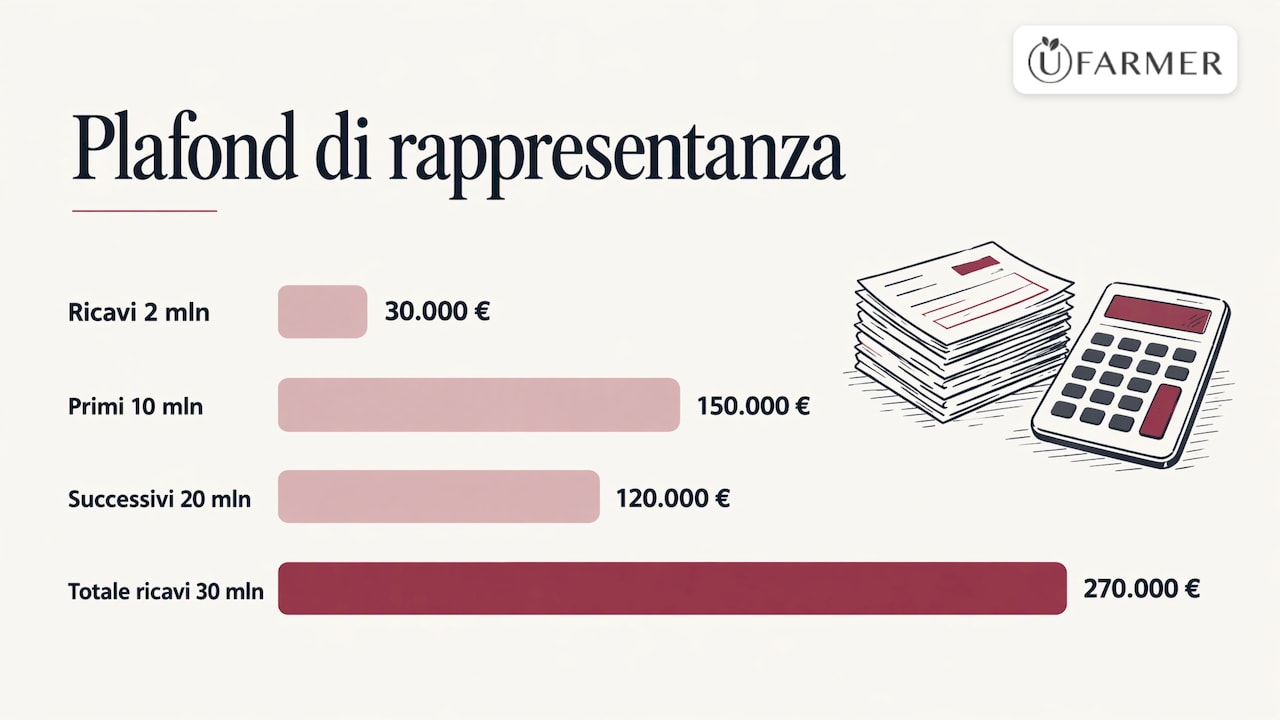
Company with €2 million in revenue. The cap is 1.5% of €2,000,000, that is €30,000. If during the year it spends €12,000 on gifts above the threshold and €8,000 on other representation expenses, the total of €20,000 falls within the cap and is all deductible.
Company with €30 million in revenue. On the first €10 million, 1.5% is worth €150,000. On the next €20 million, 0.6% is worth €120,000. The overall cap is €270,000.
Remember that there is a single cap. It is shared by gifts over €50, dinners with clients, events for company celebrations, openings and trade fair initiatives, which the 2008 decree lists among representation expenses. For lunches, dinners and overnight stays offered for public relations purposes, moreover, only 75% of the cost is recognised and that 75% still has to fit within the cap, as a guide to representation expenses explains.
The three requirements to meet
For a gift to really be a deductible representation expense it must, according to Circular 34/E of 2009, be:
- Free of charge: the recipient pays nothing and there is no consideration.
- For promotional or public relations purposes: the gift is there to look after the relationship with clients and partners.
- Reasonable and consistent with the commercial practices of your sector.
The case law of the Corte di Cassazione, Italy’s supreme court, also distinguishes representation expenses from advertising expenses on the basis of purpose: the former enhance the prestige and image of the company, the latter directly promote products and brands, as can be read in ruling no. 15843/2018. A Christmas gift to clients, in most cases, falls under representation.
Professionals: the limit of 1% of fees
If you are self-employed, the rules are different. Representation expenses, gifts included, are deductible within the limits of Article 54 of the TUIR, that is up to 1% of the fees received in the tax period, as Studio Taglione sums up in its guide to gifts. A professional with €80,000 in fees can therefore deduct up to €800 of representation expenses in the year.
Gifts to employees: a different set of rules
Gifts to staff are not representation expenses. For the company they are costs for work performed under Article 95 of the TUIR and are deductible in full, with no cap. The main difference concerns the employee.
On the payslip the gift is a fringe benefit. For the three years 2025-2027 the exemption threshold is €1,000 for workers in general and €2,000 for those with dependent children for tax purposes, under Article 1, paragraphs 390-391, of Law 207/2024, as reported by Studio Bongiorni. Within that annual amount, which includes all the benefits received, the employee pays no tax on the gift.
As for VAT, on gifts to employees the tax paid on purchase is not deductible and the free transfer is outside the scope of VAT, unless the goods are part of the company’s own business.
| Clients and partners | Employees | |
|---|---|---|
| Nature of the expense | Representation expense (Article 108 TUIR) | Expense for work performed (Article 95 TUIR) |
| Deductibility for the company | 100% up to €50; above that, within the cap based on revenue | In full |
| VAT on purchase | Deductible up to €50, if the item is not part of the company’s own business | Not deductible |
| Effect on the recipient | No formalities for the company | Fringe benefit, exempt up to €1,000 or €2,000 a year |
VAT on gifts to clients
VAT and income taxes follow independent paths. An expense can be 100% deductible and still have non-deductible VAT. The main rules, summarised in the Fiscomania guide already mentioned, are these:
- Item not part of the company’s own business, unit cost up to €50: VAT is deductible (Article 19-bis1, paragraph 1, letter h, Presidential Decree 633/72).
- Item not part of the company’s own business, unit cost over €50: VAT is not deductible. The tax that is not recovered becomes part of the cost of the gift.
- Item that is part of the company’s own business: VAT on purchase is deductible, but the free transfer becomes taxable. It is usually handled with a self-invoice or with a register of gifts.
The free transfer of goods that are not part of your business is in any case outside the scope of VAT, whatever the value. If your company does not sell wine, for example, giving bottles to clients does not require a self-invoice.
Traceable payment: compulsory since 2025
The 2025 Budget Law (Law 207/2024) tied the deductibility of representation expenses and gifts to payment by traceable means. The requirement has applied since 2025 and is confirmed for 2026 too, as Legge in Chiaro explains. If you pay in cash, the deduction is lost, even when all the other requirements are met.
In practice, a bank transfer, a company credit or debit card and other electronic payment systems in the company’s name are all fine.
The documents to keep
The deduction holds up if you can prove it. Before closing the year, put in order:
- Invoices made out to the company, with a clear description of the goods and the unit value.
- Proof of traceable payment: bank statement, transfer receipt or card receipt.
- List of recipients, useful to show the public relations purpose and to separate clients and employees, who have different rules.
- For events: programme, list of participants and purpose.
For tax purposes these documents must be kept at least until the assessment deadlines expire: 5 years from the filing of the tax return, 7 if no return was filed, as Fiscoinvestimenti points out. If in your business you issue invoices without VAT, also check the rules on the electronic stamp duty on invoices, which applies to exempt invoices above a certain threshold.
Our advice: before a large order, share the list of recipients and the expected unit value with your accountant. They are the one who knows how much of the cap your company has left for the year and how to classify each item.
Our point of view
A corporate gift works when the person who receives it remembers it. That is why we believe in gifts that last longer than a toast.
With the adoption of a vineyard or an olive tree, the client immediately receives the adoption certificate with your dedication, by email, even on the day you choose. Then, during the season, come the updates from the producer. Finally, at the end of the natural cycle and according to the adoption calendar, the wine or the extra virgin olive oil arrives at their home. Your name comes back in front of the client several times a year, not just in December.
We select small Italian producers directly, and this gives the gift a story to tell: a winery, an area, a harvest. If you want an extra touch, you can personalise bottles and packaging with vinyl lettering, a wooden tag or a personal label, for a fee, even after purchase.
On the tax side our suggestion is simple: decide the budget per recipient, pay by bank transfer or card and take the invoice to your accountant. We take care of the rest.
A gift for clients and staff that arrives all year round
If you are thinking about gifts for clients, partners or employees, our adoptions start from €85 for a vineyard and from €69 for an olive tree. These amounts are above the €50 threshold: for clients the cost therefore falls within the cap on representation expenses, while for employees it can stay within the annual fringe benefit threshold.
The adoption certificate with your dedication is sent straight away, while wine and oil arrive according to the adoption calendar. If you want something to taste to arrive by the festive season, choose our tasting boxes, the only ones that can arrive by Christmas, for orders placed by 17 December. You can browse all the adoptions and find every step in how adoption works.
Frequently asked questions
Is a €40 Christmas gift to clients deductible?
Yes, in full. A gift with a unit value of no more than €50 is 100% deductible in the year in which you incur the expense, without eating into the cap. As for VAT, if the item is not part of your business, the tax is deductible. A traceable payment is still required.
What changes if the gift costs €51?
It becomes a representation expense subject to the cap based on revenue: it is deductible only if the annual total of representation expenses stays within the limit. In addition, the VAT on purchase becomes non-deductible and is added to the cost. Remember that the threshold is measured on the whole gift.
Can I give the client a dinner instead of an object?
Yes, but the €50 rule applies only to goods. A dinner is a service: it falls under representation expenses, 75% of it is recognised and that 75% has to fit within the cap.
Do gifts to employees have a value limit?
For the company the cost is deductible in full as a staff expense. For the employee the gift is a fringe benefit, exempt up to €1,000 a year, or €2,000 with dependent children, for the three years 2025-2027. Above that amount it counts as income.
Can I pay for corporate gifts in cash?
You can, but you lose the deduction. Since 2025 gifts and representation expenses have been deductible only if paid by traceable means, such as bank transfer or card.
Sources
- Decree of the Ministry of Economy and Finance of 19 November 2008 (in Italian)
- Italian Revenue Agency, Resolution no. 27/E of 12 March 2014 (in Italian)
- Italian Revenue Agency, Circular no. 34/E of 13 July 2009 (in Italian)
- Fiscomania, corporate gifts: deductibility, VAT and IRAP (in Italian)
- Soluzione Tasse, deductibility of representation expenses (in Italian)
- Corte di Cassazione, ruling no. 15843/2018 (in Italian)
- Studio Taglione, deductibility of corporate gifts (in Italian)
- Studio Bongiorni, fringe benefit threshold 2025-2027 (in Italian)
- Legge in Chiaro, representation expenses and gifts 2026 (in Italian)
- Fiscoinvestimenti, representation and advertising expenses (in Italian)