


Reading a wine label takes two steps. First, look for the information required by law: designation, alcohol content, volume, who bottled it, allergens and lot number. This tells you what you are holding. Then read the voluntary information: grape variety, vineyard, ageing, the producer’s notes. That is where the bottle tells its story. In this guide we go through each item, where to find it, what abbreviations like DOC, DOCG and IGT mean, and how to make sense of words like Riserva, Classico or Superiore without getting confused.
In short
- The information falls into two groups: mandatory details, the same for everyone, and optional ones, chosen by the winery and the producer.
- Since 8 December 2023 ingredients and the nutrition declaration are mandatory, but they can sit behind a QR code.
- DOCG is the highest level of the Italian pyramid: stricter production rules and a numbered state seal on every bottle.
- Riserva, Classico and Superiore are not slogans: they are terms with a precise meaning, set by the production rules.
- The label says a lot, but not everything: you only discover the work in the vineyard by following the grower closely.
Contents
- Front and back label: where to look
- The information required by law
- DOCG, DOC and IGT: what really changes
- The terms: Classico, Superiore, Riserva, Vigna
- Voluntary information: the producer’s story
- A practical example: let’s read a bottle together
- Our view: the label tells, the vineyard shows
- A label with your name on it
- Frequently asked questions
- Sources
Front and back label: where to look
A bottle almost always has two labels. The front one is there to be recognised: the name of the wine, the designation, often the winery’s name and the vintage. The back label holds most of the technical information: alcohol content, allergens, lot number, bottler, sometimes a QR code and a few lines about the wine.
The law does not require every item to be on the front. It does, however, require some details to appear in the same field of vision, meaning you can read them without turning the bottle. That is why designation, alcohol content and volume are often grouped together, even on the back.
As explained in the Turin Chamber of Commerce guide to guaranteed wine (in Italian), the label is the wine’s introduction and follows precise rules, with information split into mandatory and optional. Starting from this distinction is the easiest way not to get lost.
The information required by law
These items must appear on every bottle sold in Italy. They are the wine’s identity card, and a detailed list can be found in the Quattrocalici guide to wine labelling (in Italian).
| Item | How to spot it | What it tells you |
|---|---|---|
| Product category | “Vino”, “Vino spumante”, “Vino frizzante” | The type of product, which for designated wines can be replaced by the designation itself |
| Designation | DOCG, DOC, IGT or the European PDO and PGI | The link with a territory and a set of production rules |
| Alcohol content | For example “13.5% vol” | The actual alcohol strength |
| Nominal volume | For example “75 cl” or “0.75 l” | How much wine the bottle contains |
| Bottler | “Imbottigliato da” (bottled by) followed by a name and town | Who put the wine in the bottle, which is not always the same as who made it |
| Origin | “Prodotto in Italia” (product of Italy) or similar | The country of origin |
| Allergens | “Contiene solfiti” (contains sulphites), any milk or egg derivatives | Substances that may cause reactions |
| Lot | A code preceded by “L” | The production batch, useful for traceability |
| Sugar content | Brut, Extra Dry, Dolce (sparkling wines only) | How dry or sweet a sparkling wine is |
| Ingredients and nutrition values | On the label or via a QR code | What is in the wine and how many calories it provides |
A practical tip: look closely at the bottler line. If you read “imbottigliato all’origine” or “imbottigliato dal viticoltore” (estate bottled), it usually means the same company looked after the grapes, the wine and the bottle. If you only see a name and a town far from the production area, it is worth finding out more about the supply chain.
Ingredients, nutrition values and QR code
This is the most recent change. According to the European Commission guidance published on EUR-Lex, for wines produced from 8 December 2023 the list of ingredients and the nutrition declaration are mandatory, with values per 100 ml. Wineries can show them on an electronic label reached through a QR code.
Not everything can go online, though. As this article on EU rules for wineries (in Italian) points out, allergens such as sulphites and milk derivatives must stay on the paper label. The energy value too, according to the e-label FAQs, must be shown directly on the bottle. Next to the QR code you will often find a small “i”: it signals that ingredients and nutrition values are there.
If you buy a bottle from an older vintage and cannot find a QR code, it is not necessarily a mistake: wines produced before that date can be sold without the new information until stocks run out.
Lot, vintage and disgorgement
The vintage is the year of the harvest, when the grapes were picked. It is not mandatory for all wines, but it becomes so for some designations and terms, such as Riserva.
The lot number is for traceability. There is one special case worth knowing: in traditional method sparkling wines, as Quattrocalici (in Italian) notes, the lot does not refer to bottling but to disgorgement, when the wine is separated from the yeast and prepared for sale. Many traditional method producers also print the disgorgement date in full: it tells you how long the sparkling wine has been resting in the bottle without its yeast.
DOCG, DOC and IGT: what really changes
This is the question we are asked most often. The abbreviations describe how closely the wine is tied to its territory and how strict the checks are, not a score for taste. A great IGT may please you more than an ordinary DOC. What the abbreviation does tell you is how many rules the producer had to follow.
| Abbreviation | Meaning | Rules | Sign on the bottle |
|---|---|---|---|
| DOCG | Denominazione di Origine Controllata e Garantita (controlled and guaranteed designation of origin) | Strict production rules, tougher laboratory and tasting checks, reserved for wines that have been DOC for some time | Numbered state seal, mandatory |
| DOC | Denominazione di Origine Controllata (controlled designation of origin) | Defined area, grape varieties, yields and practices set by the production rules, lab analysis and tasting panel | Seal optional |
| IGT | Indicazione Geografica Tipica (typical geographical indication) | Wider area, more freedom on grape varieties and style | Seal available on request since 2024 |
| Wine (no indication) | Table wine | No mandatory link with a specific area | None |
According to Federdoc (in Italian), DOCG is reserved for wines that have been recognised as DOC for at least 7 years, with particularly fine qualities and an established reputation. In practice it is one step further: to obtain it, a designation must already have proven its quality and reputation.
The European abbreviations are another way of saying the same thing. DOCG and DOC fall under PDO, Protected Designation of Origin. IGT falls under PGI, Protected Geographical Indication. On the bottle you may find one, the other or both.
The seal: the state guarantee
The seal (“fascetta”) is the strip of paper around the neck of the bottle, with a serial number. It works like a guarantee seal: it identifies each bottle and makes counterfeiting harder. It is mandatory on DOCG wines and optional on DOC wines. As the Sommelier blog on the seal for IGT wines (in Italian) explains, since 2024 IGT wines can request it too.
So be careful: the seal alone no longer tells you for certain that a wine is DOCG. Always check the abbreviation on the label.
The terms: Classico, Superiore, Riserva, Vigna
These are words that appear next to the designation and that many people read as simple adjectives. In fact they have a technical meaning and can only be used with DOC and DOCG wines, as set out in each set of production rules.
- Classico: the wine comes from the oldest area of origin within the designation, its historic heart.
- Riserva: the wine has been aged for longer. According to the Ente Vini Bresciani page on the terms (in Italian), this means at least two years for reds and one for whites, but the production rules may require more.
- Superiore: it indicates higher quality than the basic version, usually linked to a higher minimum alcohol content and lower yields, within the limits set by the production rules.
- Vigna followed by a name: the grapes come from a specific vineyard with a registered name. It is the closest thing to the field you can find on a bottle.
The terms can also be combined: “Classico Riserva” or “Classico Superiore” add up the requirements of both. When you see them together, you know the producer has met more conditions.
Voluntary information: the producer’s story
Everything the law does not require, and the producer chooses to write, belongs to this group. As VerdeGusto notes in its label guide (in Italian), these are often the items that really tell you about the wine: production method, vineyard of origin, choices in the cellar.
Here are the most common ones and how to read them:
- Grape variety: the name of the grape, for example Nebbiolo or Vermentino. It helps you imagine the style even if you don’t know the designation.
- Method: “metodo classico” means the second fermentation takes place in the bottle, “metodo Martinotti” or “Charmat” means it takes place in large closed tanks.
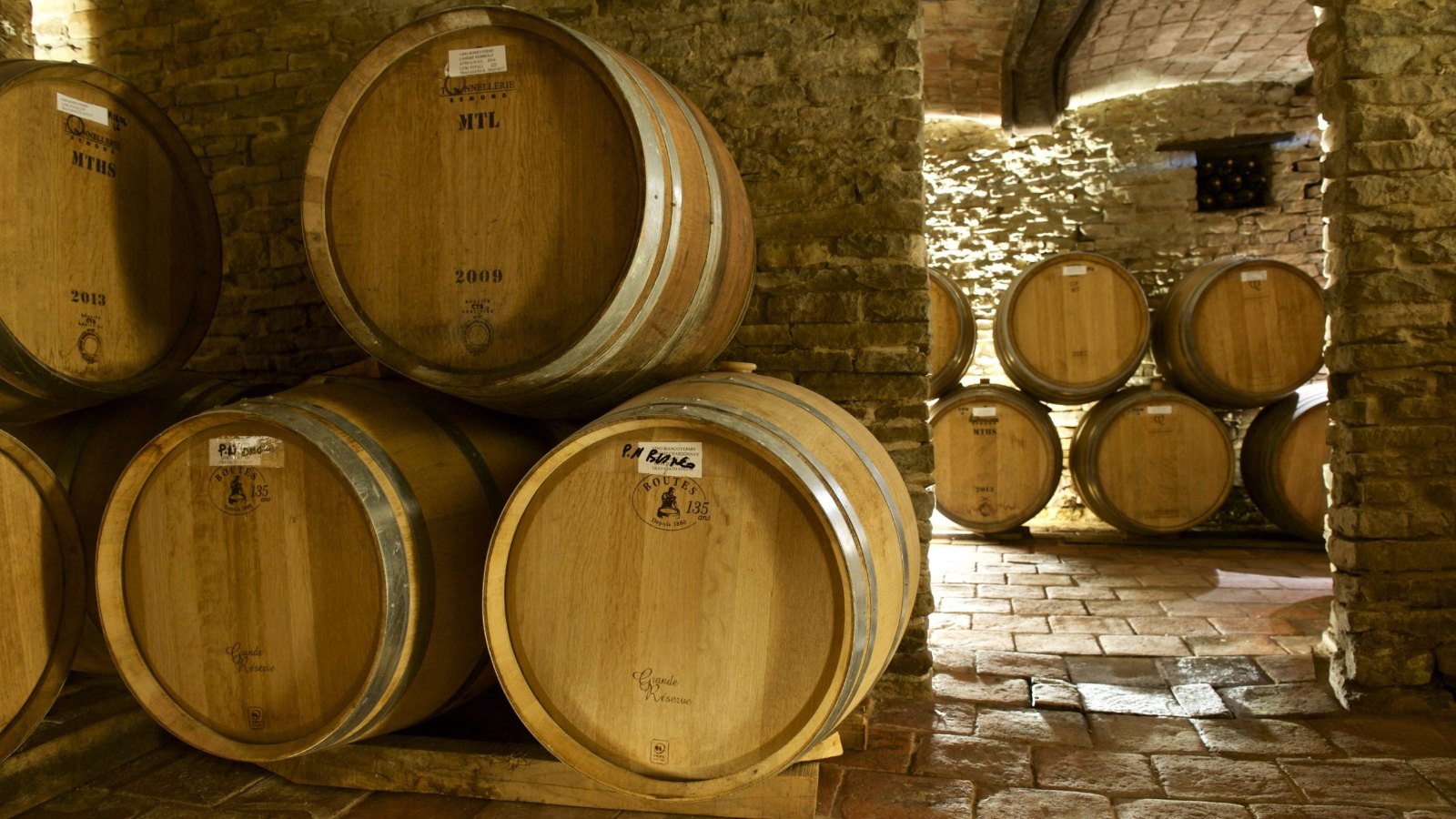
- Ageing: phrases such as “aged in barrique” or “12 months in large casks”. Wood changes the aromas and the structure. If you want to understand what happens during fermentation in oak barrels, it is a step that explains well why two wines from the same grape can taste different.
- Serving temperature and food pairings: practical tips, especially useful if the bottle is a gift.
- Certifications: the European organic logo, for example, tells you how the grapes were grown.
- Notes on the harvest: some wineries describe how the year went. These are the most personal lines on the whole label.
A simple rule: mandatory items can be checked, voluntary ones are read with trust but also with a little critical sense. “Selezione” or an Italian-style “gran cru”, for example, do not always have a meaning set by law.
A practical example: let’s read a bottle together
Let’s take a made-up label, built like real ones: “Colli del Sole DOC Superiore, Vigna del Pozzo, 2021 vintage, 14% vol, 75 cl, estate bottled by Azienda Agricola Rossi, contains sulphites, L.22-034”, plus a QR code with an “i” on the back label.
Here is how we read it, one step at a time:
- Designation: DOC. The wine comes from a defined area and follows production rules, with lab analysis and tasting before sale.
- Term: Superiore. Compared with the basic Colli del Sole, the rules require higher standards.
- Vigna: Vigna del Pozzo. The grapes come from a single registered vineyard.
- Vintage: 2021, the harvest of that year.
- Strength and volume: 14% vol in 75 cl, a wine with good structure.
- Bottler: estate bottled, so the grower also looked after the bottle.
- Allergens and lot: sulphites declared, lot number to trace the production.
- QR code: scan it to find ingredients and nutrition values per 100 ml.
In one minute you have understood origin, level of control, likely style and supply chain. Without even opening the bottle.
Our view: the label tells, the vineyard shows
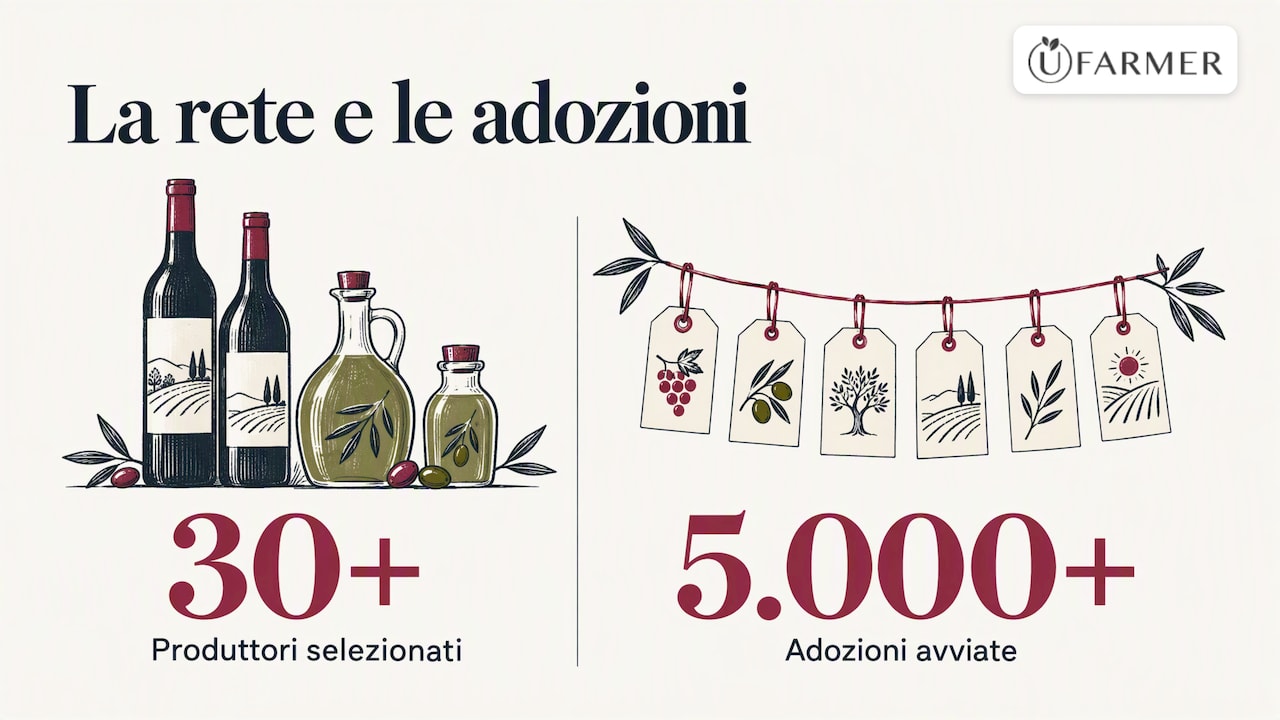
Every day we work with small wineries and olive oil producers selected across Italy, more than 30 today, and we have seen more than 5,000 adoptions begin. This is where our conviction comes from: the label is a great starting point, but it is a snapshot. It tells you where the wine comes from and which rules it followed. It cannot show you the winter pruning, the flowering, the wait before the harvest, the ageing in the cellar.
That is why we think the best way to learn to read a label is to see what lies behind it. When you follow a vineyard through seasonal updates, words like “harvest”, “ageing” or “designation” stop being abbreviations and become real steps in a year of work. And when the bottle arrives, you read it with different eyes: you know who made it and how.
The wineries we work with include, for example, Scarzello, Prunotto and Deltetto. On their pages you can find out who they are before you even choose. Our advice is simple: read the label carefully, then try to get to know the producer. Together, the two give you the full picture.
A label with your name on it
If you like the idea of a bottle whose whole story you know, you can go one step further. With UFarmer you can adopt a vineyard from €85 or adopt an olive tree from €69, and receive the product of one of our selected producers.
Here is how it works, in short:
- The adoption certificate with your message arrives straight away by email, or on the day you choose for the gift.
- Follow the year of your vineyard or olive tree with seasonal updates.
- Wine and oil arrive according to the adoption calendar, when the product is ready.
- You can personalise the bottles, for an extra charge, with vinyl lettering, a wooden tag or a personal label.
If you would like to find out which style you prefer first, our tasting boxes let you taste before you adopt. With the holidays coming, they are also a gift to open under the tree: they arrive by Christmas for orders placed by 17 December, and you can find all our ideas among our adoptions to give as a gift. For step-by-step details, see the page on how adoption works.

Frequently asked questions
What is the difference between DOC and DOCG?
Both link the wine to an area and a set of production rules, but DOCG is the highest level. It is reserved for wines that have been DOC for at least 7 years, involves stricter checks and a numbered state seal on every bottle. A DOC wine may have the seal, but it is not required.
What does IGT mean on the label?
IGT stands for Indicazione Geografica Tipica (typical geographical indication). The wine comes from a stated geographical area, usually wider than a DOC, with less strict rules on grape varieties and style. Many producers choose it precisely for this freedom, so it does not mean lower quality.
How do you remove a label from a bottle without damaging it?
A method popular with enthusiasts is to fill the empty bottle with very hot water and wait for the heat to soften the glue, then gently lift one corner. It is best to avoid harsh solvents, which can alter the colours of the print.
Are there apps that recognise a wine from its label?
Yes. Several apps photograph the label and compare it with large databases to identify the winery, grape and vintage. They work best with a well-lit photo taken straight on: the curve of the bottle distorts the image and can make recognition fail.
How much should a bottle cost to be good?
There is no minimum price that applies to everyone. Quality depends above all on the care taken in the vineyard, the yields and the producer’s choices. Reading the label carefully, and knowing who makes the wine, helps you understand what you are buying more than the price does.
Sources
- Turin Chamber of Commerce: Il vino garantito (in Italian)
- Quattrocalici: Leggere le etichette dei vini (in Italian)
- EUR-Lex: Commission Notice C/2023/1190
- AlimentareB2B: wine labelling, ingredients and e-label (in Italian)
- e-label: frequently asked questions about the electronic label
- Federdoc: the pyramid of Italian wines, DOCG wines (in Italian)
- Il blog del Sommelier: state seal for IGT wines too (in Italian)
- Ente Vini Bresciani: the terms Classico, Riserva, Superiore, Vigna (in Italian)
- VerdeGusto: the wine label, how to read it (in Italian)