


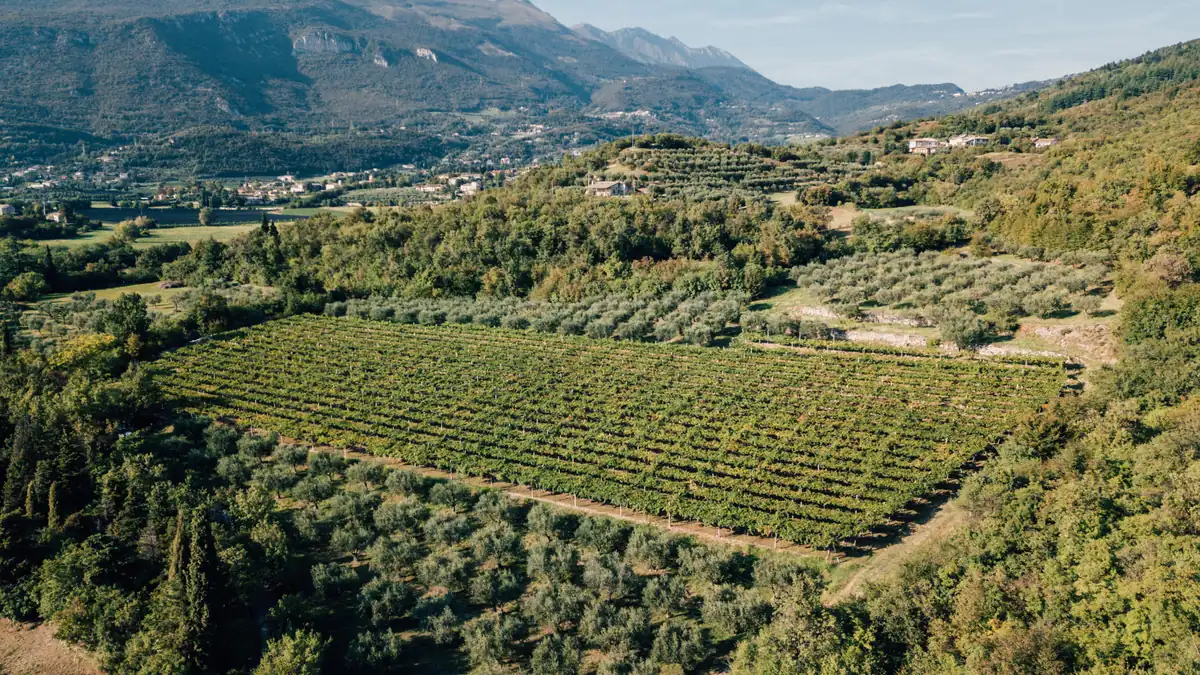
The vine cycle is the sequence of stages the plant goes through every year. It begins with winter dormancy, moves on through the spring awakening, flowering and the transformation of flowers into berries, and reaches the ripening of the grapes and the harvest. Then it goes back to dormancy. In Italy the calendar runs more or less from March to November. It changes, however, from area to area and from one vintage to the next: in 2026 picking started about ten days early. If you like wine, knowing these stages lets you see a whole year’s work in every bottle. The loveliest way to discover it is to follow it on a real vineyard: by adopting a vineyard with UFarmer you follow the season of a small Italian producer up to the harvest and receive your wine at home.
In short
- The vine has three overlapping cycles: the annual one (from awakening to dormancy), the reproductive one, which for each bunch lasts two seasons, and the life cycle, in other words the whole life of the plant.
- The main stages, in order: winter dormancy, bleeding, bud break, shoot growth, flowering, fruit set, veraison, cane ripening, ripening, harvest and leaf fall.
- The harvest in Italy generally runs from August to October, stretching into November for late grapes. In 2026 it started about ten days earlier than usual.
- The right time is decided by the variety, the climate and the wine you want to make: grapes for sparkling wines first, full-bodied reds and sweet wines later.
- Following an adopted vineyard is a tangible way to see these stages up close, and an original gift idea too.
Contents
- Three cycles in a single plant
- The stages of the vine month by month
- Winter: dormancy and pruning
- Spring: bleeding and bud break
- Flowering and fruit set: the berries are born
- Summer: veraison and cane ripening
- Ripening: when the grapes are ready
- When the harvest takes place in Italy
- Following the cycle up close: adopt a vineyard
- Our point of view
- Frequently asked questions
- Sources
Three cycles in a single plant
When people talk about the vine cycle they actually mean three different cycles, running together.
The annual cycle is the one you see walking through the vineyard during the year. It includes shoots, leaves, bunches, the hardening of the canes and the fall of the foliage in autumn. Agronomists divide it into two parts. The teaching material from the University of Perugia course on phenological stages calls them the vegetative sub-cycle (winter dormancy, bleeding, bud break, shoot growth, cane ripening, leaf fall) and the reproductive sub-cycle (from the formation of the buds to the ripening of the grapes).
The reproductive cycle is the most surprising. The bunch you pick in September is not born that same spring. It starts to form the year before, inside the buds. According to a guide to grapevine phenology from New Mexico State University, the inflorescences begin to take shape in the first year inside the buds and emerge in the second as clusters of flowers. From the first outline of the bunch to picking, 14-15 months go by. That is why a difficult vintage can also weigh on the following year’s production.
The life cycle covers the whole life of the plant: planting, the young years, full production and old age. It explains why a young vine and an old one give different grapes on the same soil.
In this guide we focus on the annual cycle, the one that decides what each harvest is like.
The stages of the vine month by month
Technicians describe each stage with coded scales. The most widely used today is BBCH, an international system that assigns a number to each stage of the plant’s development. The most historic is Baggiolini, which uses letters. The BBCH and Baggiolini equivalence sheet from ERSA of Friuli Venezia Giulia puts the two scales side by side. For wine lovers, the names and the months are enough.
| Stage | Approximate period in Italy | What you see in the vineyard |
|---|---|---|
| Winter dormancy | December-February | Bare plant, pruning under way |
| Bleeding | March-April | Drops of sap from the pruning cuts |
| Bud break | March-April | Swollen buds, first green tips |
| Shoot growth | April-June | Leaves and tiny bunches still closed |
| Flowering | May-June | Small, greenish, scented flowers |
| Fruit set | June | The flowers become tiny green berries |
| Veraison | July-September | The berries change colour |
| Cane ripening | August-autumn | The green canes turn into brown wood |
| Ripening and harvest | late August-October | Grapes ready, picking |
| Leaf fall | October-November | Yellow and red leaves, then the plant goes bare |
The months are approximate. In the South and in warm areas everything comes earlier, in the mountains and in the North it comes later. The variety matters too: an early variety can be picked weeks before a late one grown a few kilometres away.
Winter: dormancy and pruning
After leaf fall the vine goes into dormancy. From the outside it looks still, but it is storing in its trunk and roots the reserves it will need to start again in spring. Next year’s buds are already there, protected by scales, and inside some of them the outline of the future bunches is already present.
This is the pruning season. The grower chooses which canes to keep and how many buds to leave. It is a decision that weighs on the whole vintage: fewer buds mean fewer bunches, usually more concentrated. The winter cold is not an enemy. The plant needs it to complete its dormancy and start again evenly.
Spring: bleeding and bud break
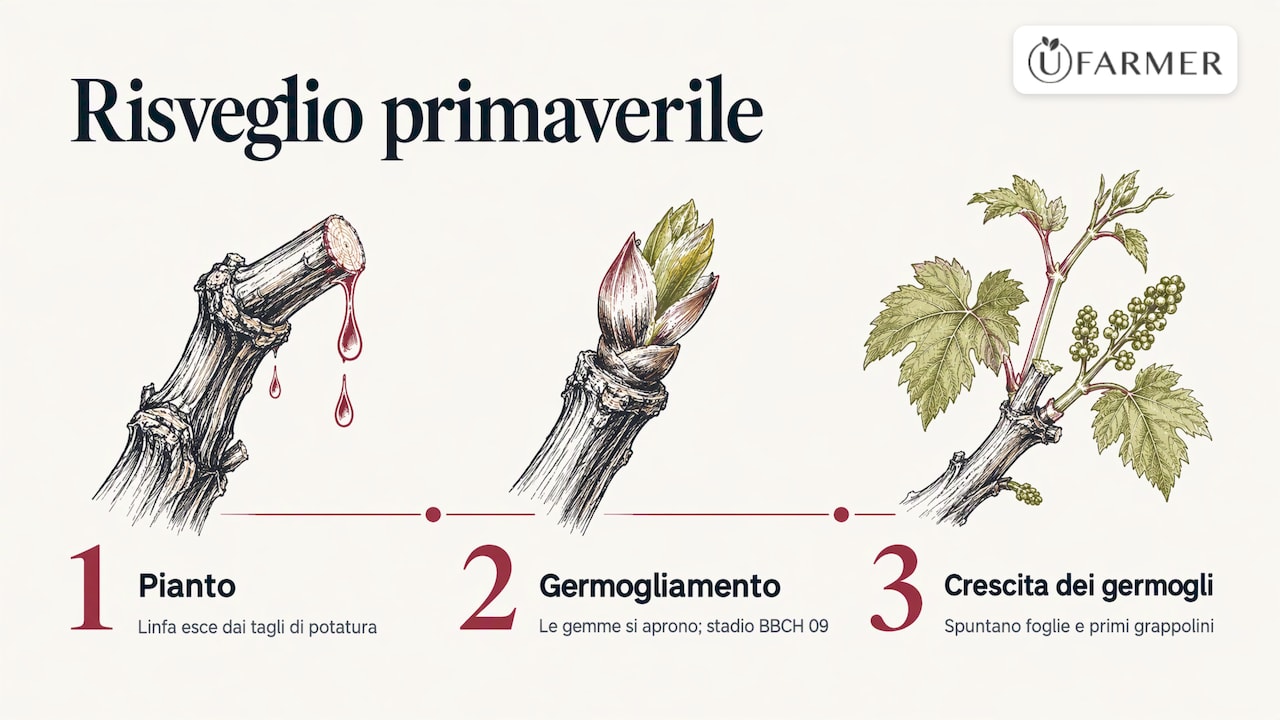
The first sign of awakening is bleeding. When temperatures rise the roots start absorbing water again, and drops of clear sap come out of the pruning cuts. It is a normal phenomenon and lasts a few weeks: the plant is getting going again.
Then comes bud break. The buds swell, open and show their first green tips. On the BBCH scale this stage has code 09, as noted in the sheet on viticulture and climate from the Province of Trento, which uses it as a reference together with full flowering and veraison to measure the effects of climate change on the vine.
It is also the most delicate moment for the grower. Newly emerged shoots are vulnerable to late frosts: one night below zero in April can compromise part of the crop. In the following weeks the shoots grow quickly, the leaves come out and the first tiny bunches appear, still closed and compact. If you want to look more closely at this season, you will find everything in our guide to bleeding, bud break and flowering in spring.
Flowering and fruit set: the berries are born
Between May and June the vineyard flowers. Vine flowers are small and greenish, not very showy but scented. In most cultivated varieties they are hermaphrodite, in other words they have both the male and the female part, and they are fertilised without the need for bees. Full flowering corresponds to BBCH code 65.
Straight afterwards comes fruit set. It is the moment when the fertilised flowers become fruit: the petals fall and in their place are tiny green berries, the size of a peppercorn and then of a pea. Not all the flowers set. Rain, strong wind or cold during flowering can reduce the number of berries per bunch, and it is one of the first moments when you get an idea of what the vintage will be like.
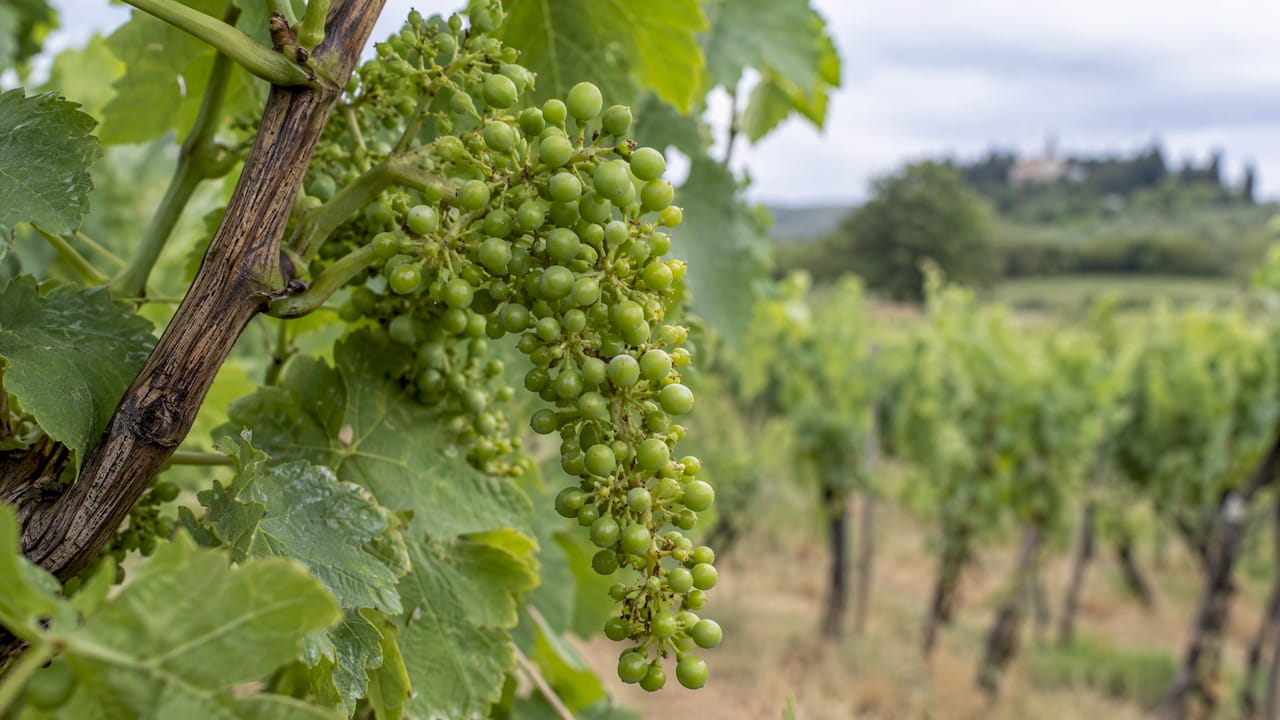
At this stage the vine-covered hills are at their greenest. That is why some people choose late spring for a marriage proposal in the vineyard, among rows laden with newly formed bunches.
Summer: veraison and cane ripening
Summer is the time of transformation. For weeks the berries grow while staying green and hard. Then, in a few days, comes veraison: the berries, as the ERSA sheet describes, become translucent and change colour depending on the variety. White grapes turn towards golden yellow, red ones towards purple and black. On the BBCH scale it is stage 81, the beginning of ripening.
Inside the berry everything changes. Sugars rise, acidity falls, the skin starts to build up colour and aromas. Our guide to what veraison is and what changes in the grapes describes it in detail.
In the same period cane ripening takes place, called agostamento in Italian after the month of August. The year’s green canes become woody and brown and build up reserves. They will be the wood the grower works on with the following winter’s pruning.
Ripening: when the grapes are ready
After veraison the grapes ripen for a few weeks. The study on grape ripening from the V.I.S.T.A. Lucido Project of the Consorzio Sicilia Doc breaks the process down into precise timings:
- herbaceous period: 30-65 days, with the green berry growing;
- veraison period: 6-30 days;
- ripening period: 25-50 days;
- over-ripening: the next stage, which is sought only for some wines.
But when do we say the grapes are ripe? Producers look at three things together:
- Technological ripeness: the right balance between sugars and acids. It decides the alcohol content and the freshness of the wine.
- Phenolic ripeness: the colour and tannins of the skins and seeds are ready. It matters above all for reds.
- Aromatic ripeness: the typical aromas of the variety have reached their balance.
The same study explains that finding the balance between these three kinds of ripeness is even harder in hot, dry climates. That is why the harvest date is not decided on the calendar: it is decided by tasting the berries and measuring sugars and acidity, row by row.
When the harvest takes place in Italy
In a normal vintage the Italian harvest begins at the end of August with the early grapes and continues until October. For wines from late-harvested grapes it can go on into November. The order follows a simple logic:
- first the grapes for sparkling wines, picked early because high acidity is needed;
- then the whites and the fresher reds;
- after that the full-bodied reds made for ageing, which need more time to ripen skins and tannins;
- last of all the sweet and late-harvest wines, left on the plant so that the sugars concentrate.
The climate, however, is shifting the calendar. In 2026, according to Coldiretti, the harvest got under way ten days early because of the intense heat that sped up the ripening of the bunches. The analysis reported by WineNews adds that the 2026 harvest was spread over almost five months, starting from Sicily and Oltrepò Pavese. In Tuscany there was talk of Sangiovese picked around mid-August, an unusual date for a red that is traditionally harvested between September and November.
Agricultural institutions confirm it too. For the North-East, Veneto Agricoltura recorded in 2026 a hot, dry summer, with above-average temperatures, which brought forward the main phenological stages of the vine across the board. The year before, the 2025 Harvest Report by Assoenologi, UIV and ISMEA had already described an early harvest in many areas and a long picking season above all in the South.
The result is that every vintage tells a different story. Two bottles from the same producer, from two different years, can have different aromas, structure and alcohol content precisely because of how the cycle went. If you are curious about the picking itself, with manual and mechanical methods, you will find everything in our guide to how the grape harvest works.
Following the cycle up close: adopt a vineyard
Reading about the stages of the vine is one thing. Following them on a real vineyard, knowing that the wine will arrive at your home, is another. With UFarmer you can adopt a vineyard from a selected small Italian producer, from €85 as a one-off payment. You receive the adoption certificate with your dedication, updates from the producer during the season and, at the end of the natural cycle, your wine at home.
It is a gift that lasts a year. The adoption certificate with your dedication arrives by email straight away, or on the day you choose: perfect for a birthday, an anniversary or a corporate gift. The wine arrives according to the adoption calendar, when the producer has completed their work. You can personalise the bottles for a fee with vinyl lettering, a wooden tag or a personal label, even after purchase.
You will find all the wineries available among the vineyard adoptions. If the gift is for someone who loves olive oil, there is also the adoption of an olive tree, from €69 as a one-off payment. And if you want someone to taste a producer first, the tasting boxes are the quickest choice: only tasting boxes arrive by Christmas, for orders placed by 17 December. For the step-by-step details there is the how adoption works page.
Our point of view
A wine is the fruit of a year’s work, and the vine cycle shows it stage after stage. A frost in April, rain during flowering, a summer hotter than usual: every step leaves a mark in the glass.
That is why we select small Italian producers directly. They are the ones who live the vineyard every day, and with their seasonal updates they take you inside that work, from pruning to the harvest. Anyone who adopts a vineyard is not just buying a bottle: they follow the season of a real plant and wait for their own wine knowing where it comes from.
We believe this is what makes the gift original and personal. The adoption certificate with your dedication arrives straight away, the wine arrives when nature and the producer have finished their work. In between there is a year in the vineyard to tell.
Frequently asked questions
How long does the annual vine cycle last?
The annual cycle runs from the spring awakening, with bleeding between March and April, to winter dormancy, which begins after leaf fall between October and November. The active part therefore lasts from six to eight months, depending on the area and the variety. The reproductive cycle of a single bunch, on the other hand, extends over two seasons: from the first outline to picking, 14-15 months go by.
When is the harvest season in Italy?
The harvest usually runs from the end of August to October, beginning with the grapes for sparkling wines and ending with the full-bodied reds. Late-harvest grapes can stay on the plant until November. In recent years the heat has brought picking forward: in 2026 it started about ten days earlier than usual.
What is the bleeding of the vine?
It is the seeping of drops of clear sap from the pruning cuts, at the beginning of spring. It happens because the roots start absorbing water again and the plant gets going again. It is a normal sign of awakening and comes a few weeks before bud break.
Can I give the adoption of a vineyard at Christmas?
Yes. The adoption certificate with your dedication arrives by email straight away, or on the day you choose, so you can hand it over on Christmas morning too. The wine arrives according to the adoption calendar. If you want something to taste under the tree, tasting boxes are the only option that arrives by Christmas, for orders placed by 17 December: you will find them on the tasting box page.
Sources
- University of Perugia, wine grapes: phenological stages, physiology and frost damage (CESAR) (in Italian)
- New Mexico State University, Grapevine Phenology: Annual Growth and Development
- ERSA Friuli Venezia Giulia, vine phenology sheet: BBCH and Baggiolini (in Italian)
- Autonomous Province of Trento, viticulture in 2099: the impact of climate change on phenology (in Italian)
- Consorzio Sicilia Doc, V.I.S.T.A. Lucido Project: the grape ripening process (in Italian)
- AgroNotizie, 2026 harvest ten days early (in Italian)
- WineNews, the 2026 harvest takes shape in Italy: the Coldiretti analysis (in Italian)
- Veneto Agricoltura, 2026 harvest: first data and forecasts (in Italian)
- Assoenologi, UIV, ISMEA, 2025 Harvest Report (in Italian)