


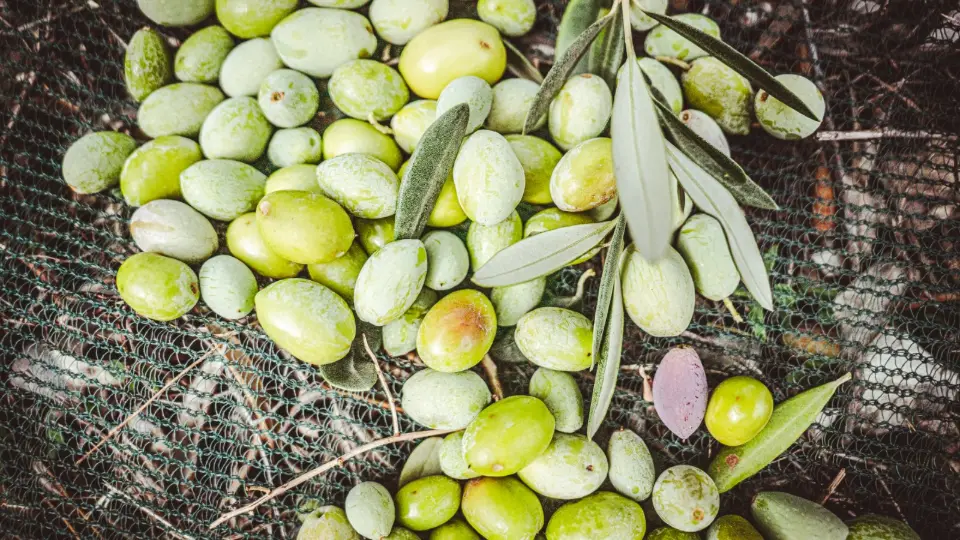
A mature olive tree grown in Italy gives, in a normal year, just a few litres of oil: roughly 2 to 5. The reason is simple: a tree produces a few dozen kilos of olives, and on average 12-18% of their weight is extracted as oil. Every bottle of extra virgin olive oil really is the fruit of a year of work on one specific tree. That is why adopting an olive tree from a small Italian producer, following its season and receiving its oil at home is a gift with real, concrete value, not just a symbolic one. Here you will find the numbers, how they are calculated and why they change from one year to the next.
In short
- Per tree: data collected from Italian farms indicate about 10 to 28 kg of olives per tree, which is roughly 2 to 5 litres of oil.
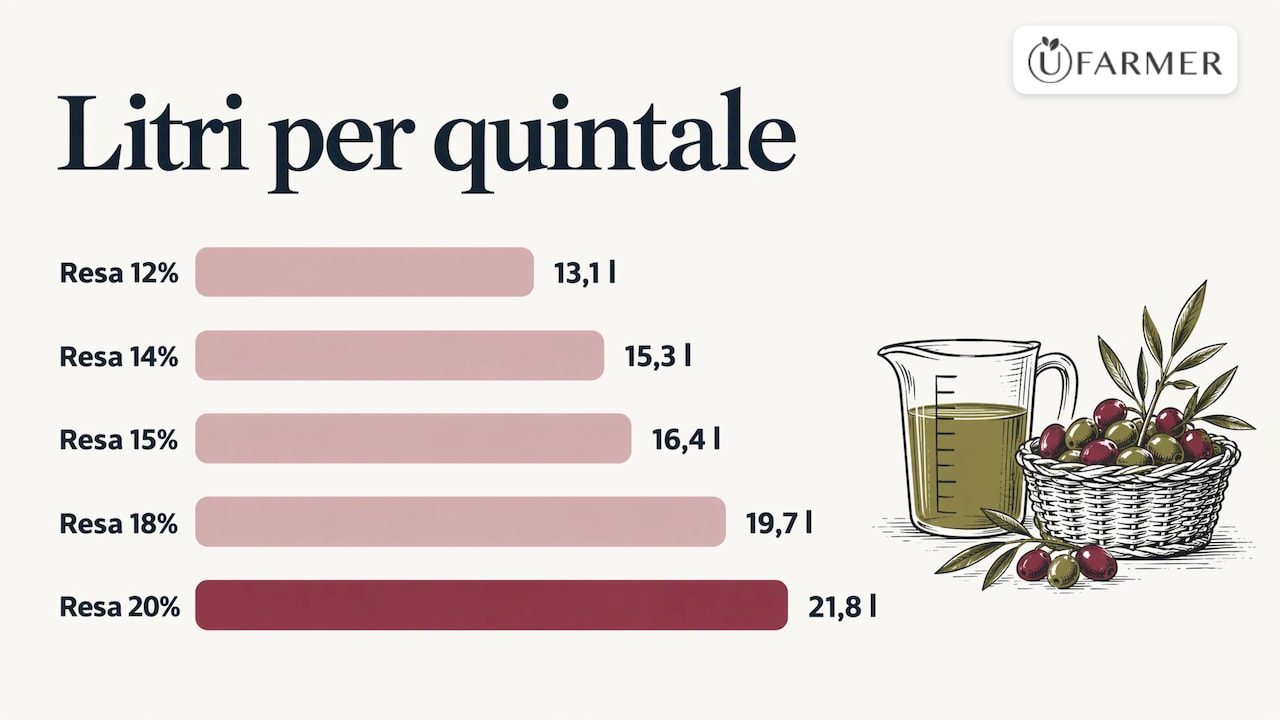
- Per quintal: with a 15% yield, 100 kg of olives give 15 kg of oil, about 16.4 litres.
- For one litre: you usually need 5 to 7.5 kg of olives, depending on the yield.
- The yield changes with variety, climate, water, ripeness of the olives and vintage: two consecutive seasons can be very different.
- A high yield does not mean better oil: in fact, many PDO specifications set a maximum yield.
Contents
- How much oil an olive tree makes, in numbers
- Yield per tree and oil yield: two different numbers
- How the yield is calculated: from quintal to litre
- Why the yield changes from one tree to another
- A high yield does not mean better oil
- What it means for anyone adopting an olive tree
- Our point of view
- Frequently asked questions
- Sources
How much oil an olive tree makes, in numbers
To answer you need two figures: how many olives the tree bears and how much oil is obtained from those olives. The most reliable Italian sources give these reference points.
In an ISMEA survey of the olive oil supply chain, reported by Teatronaturale(in Italian), the Italian farms interviewed recorded in the 2019/20 season an average yield of 28 kg of olives per tree and an oil yield of about 16%.
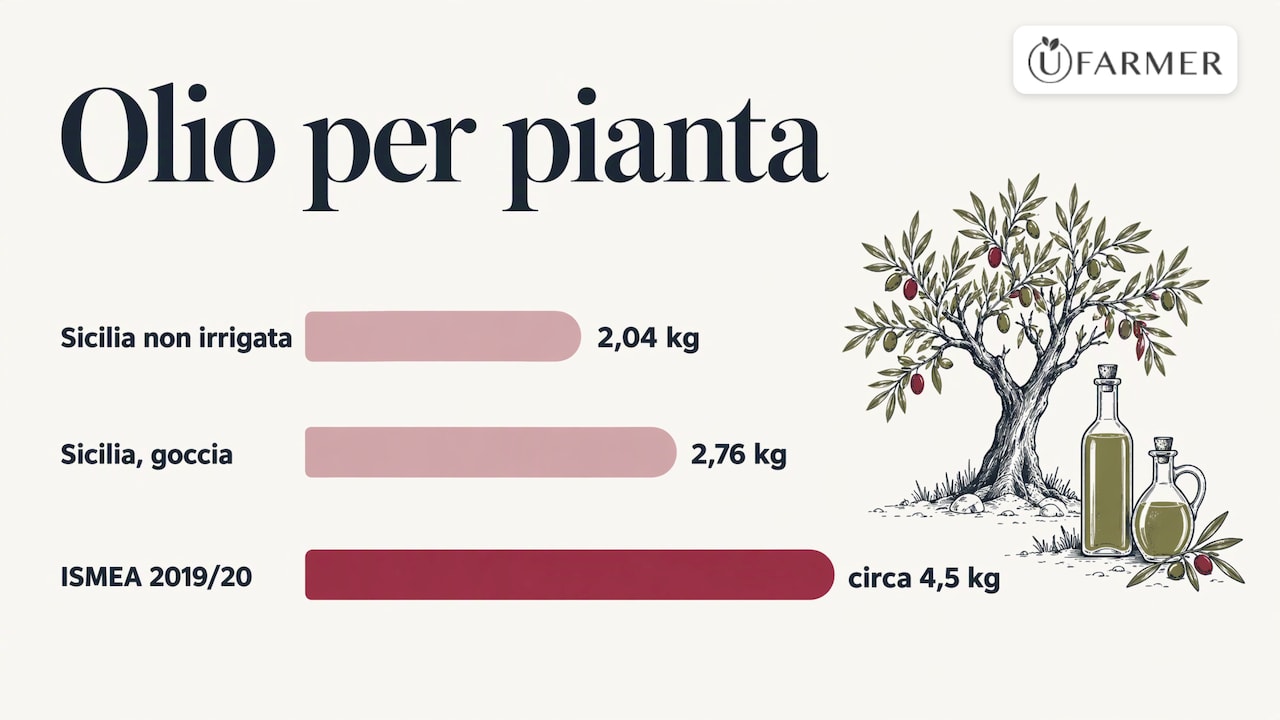
An academic study of Sicilian olive groves (Maesano and colleagues, 2021) measured instead between 10.72 and 15.31 kg of olives per tree, with oil yields of 18-19% and between 2.04 and 2.76 kg of oil per tree, depending on whether the grove was irrigated or not.
Converted into litres, these numbers give a clear picture:
| Case | Olives per tree | Oil yield | Oil per tree | In litres (approx.) |
|---|---|---|---|---|
| Sicily, non-irrigated grove | 10.72 kg | 19% | 2.04 kg | 2.2 l |
| Sicily, drip irrigation | 15.31 kg | 18% | 2.76 kg | 3.0 l |
| Average of Italian farms, ISMEA 2019/20 | 28 kg | about 16% | about 4.5 kg | about 4.9 l |
To go from kilos to litres you use the density of the oil: one litre of oil weighs about 0.916 kg, so you divide the weight by 0.916.
In practice: a medium-sized tree, in a regular year, fills a few half-litre bottles. Very large, centuries-old trees can give more, while young trees or trees in an off year give much less.
Yield per tree and oil yield: two different numbers
When people talk about “yield” they often mix up two different measures, and that is where the confusion starts.
- Production per tree tells you how many kilos of olives a tree bears. It depends mainly on the size of the canopy, the age of the tree, pruning and the season.
- Oil yield is the percentage of oil obtained from the olives: if 100 kg of olives give 15 kg of oil, the yield is 15%. It depends mainly on the variety and the ripeness of the fruit.
The two numbers multiply: 20 kg of olives with a 15% yield give 3 kg of oil, about 3.3 litres. This is why a tree heavy with olives does not guarantee a lot of oil on its own, and a tree with fewer but very “fatty” fruits can be a surprise.
Then there is a third measure, which matters more to farmers than to oil lovers: production per hectare. Modern, high-density groves produce more oil per hectare, while traditional groves, with fewer but larger trees, rely more on the single tree. In the ISMEA survey mentioned above the average was 5,925 kg of olives per hectare.
How the yield is calculated: from quintal to litre
The formula is simple and every producer uses it after milling, the crushing of the olives that separates the oil from the water and the fruit paste:
Yield (%) = kg of oil ÷ kg of olives × 100
A concrete example: 350 kg of olives that give 49 kg of oil correspond to a 14% yield. Be careful to use kilos and not litres: since oil is lighter than water, putting litres into the formula makes the yield look almost one and a half points higher.
From here you get the two most frequent questions: how many litres you get from a quintal (100 kg) of olives, and how many kilos of olives you need for one litre.
| Oil yield | Litres from 1 quintal of olives | Kg of olives for 1 litre |
|---|---|---|
| 12% | 13.1 l | 7.6 kg |
| 14% | 15.3 l | 6.5 kg |
| 15% | 16.4 l | 6.1 kg |
| 18% | 19.7 l | 5.1 kg |
| 20% | 21.8 l | 4.6 kg |
Two quick rules for doing the maths in your head:
- Litres from a quintal: multiply the yield by 1.09. At 15% you get about 16.4 litres.
- Kg of olives for one litre: divide 91.6 by the yield. At 15% you need about 6.1 kg.
What yields can you expect in Italy? According to OlivoNews(in Italian), in the 2025 season average yields ranged between 12.5% and 16%. In a year like that you therefore needed between about 5.7 and 7.3 kg of olives for each litre of extra virgin olive oil.
The same article gives an idea of what the raw material is worth: with olives paid between 70 and 110 euros per quintal, the cost of the olives alone for one litre of oil was 4.80-6.30 euros, before milling, bottling and transport. It is a good reminder when you look at the price of a well-made extra virgin olive oil.
Why the yield changes from one tree to another
There is no single number that applies to everyone. TheInternational Olive Council, the international body that brings together the producing countries, groups the factors that affect yield into five areas: variety, growing environment, climate and weather, agronomic management and the layout of the grove. Let us look at them one by one, with what they mean for the oil that reaches your table.
The variety
The variety, or cultivar, sets the potential: the maximum yield of an olive is written in its genetics. Italy has hundreds of varieties, from the small, flavourful olives of the North to the larger ones of the South, and each has its own yield and flavour profile. If you want to understand how shape, flavour and uses in the kitchen change, there is an overview of Italian olive varieties that helps you find your way.
Climate, water and light
Water stress while the oil is building up and high temperatures reduce the tree’s ability to produce oil, while olives grown in well-lit positions are heavier and richer in oil, as theInternational Olive Councilalso explains. The Sicilian study confirms it: with drip irrigation the same area went from 10.72 to 15.31 kg of olives per tree.
Fruit drop and the olive fly
Only a small share of the flowers becomes an olive ready to harvest. Research published by Olivo e Olio by Edagricole (in Italian) explains that many fruits fall before the harvest: partly this is a natural phenomenon, partly it is caused by the olive fly and by summer drought. It is one of the reasons why the producer’s work in the field counts as much as the tree itself.
The vintage and the area
Olive trees often alternate on years and off years. According tothe IRVOS analysis of Ismea and Agea data(in Italian), the 2024/2025 season was an off year with a 24% drop nationally, but with very different results across areas: the North and the Centre increased production, while in Apulia it almost halved.
The oil yield also varies a lot from province to province. The provisional 2023 data published by Agricultura.it (in Italian) gave, for example:
| Province | Average yield 2023 (provisional data) |
|---|---|
| Imperia | 17.6% |
| Piacenza | 16.6% |
| Crotone | 16.5% |
| Agrigento | 16.4% |
| Savona | 15.8% |
| Turin | 9.5% |
Between the highest and the lowest yield there is almost a twofold difference: with the same quantity of olives, Imperia obtained almost twice as much oil as Turin.
A high yield does not mean better oil
This is the most useful thing to know if you love quality oil. Olives harvested early, still green or at the start of veraison (the moment when the skin starts to change colour), yield less than ripe ones. Many producers still choose to harvest early, because they want a fresher, more fragrant oil with livelier bitter and peppery notes. They accept fewer litres in exchange for more character.
The rules of the designations say so too. The specification of the Val di Mazara PDO published by the Italian Ministry of Agriculture (in Italian) sets a maximum oil yield from the olives of 22% and requires milling within two days of harvesting. The Terra d’Otranto PDO specification sets the limit at 20% and requires the olives to be processed within 24 hours. A cap on yield exists precisely to protect quality.
The moment of the harvest is therefore a choice of style for the producer, not just a matter of the calendar. If you want to know when olives are harvested in the different regions and which signs tell you it is the right time, you will find everything in our guide on when olives are harvested. What happens after milling also changes the result in the bottle: we talk about it in the article onfiltered or unfiltered olive oil.
What it means for anyone adopting an olive tree
If a tree gives a few litres a year, and those litres depend on variety, season and the producer’s choices, then the oil of one specific tree is a rare and personal product. This is the idea behind adopting an olive tree with UFarmer.
With UFarmer you can adopt an olive tree from selected small Italian olive oil producers, starting from €69. Here is how it works:
- Your certificate of adoption with your dedication arrives straight away by email, or on the day you choose if it is a gift.
- Updates from the producer tell you about the tree’s season all the way to the harvest.
- The extra virgin olive oil arrives at your home at the end of the natural cycle, according to the adoption calendar.
- The packaging can be personalised for a fee, even after purchase, with vinyl lettering, a wooden tag or a personal label.

You can choose from the available olive tree adoptions and read how the adoption works step by step. If you would rather get to know a producer through their products first, the tasting boxes are designed exactly for that, and they are also the only UFarmer gift that can arrive before Christmas. The same principle applies to corporate gifts: a personal certificate for each person and an oil with a precise story.
Our point of view
When someone asks us how much oil an olive tree produces, the answer in litres is only half the story. The other half is everything that happens before: the flowering, a dry or rainy summer, the choice of the harvest day, the rush to take the olives to the mill.
That is why we work with small Italian olive oil producers that we select directly. Anyone who adopts an olive tree is not buying just any bottle: they follow the season through the producer’s updates and understand why that year the oil has that aroma and that character.
The numbers in this article say something simple: quality extra virgin olive oil comes from a few olives at a time and from many careful choices. An adoption makes this visible, and that is why we consider it an original, personal and concrete gift. If you want to meet the people behind it, you can start from the stories of our Italian olive oil producers, such as Il Merlo.
Frequently asked questions
How much oil do you get from a quintal of olives?
It depends on the yield. With a 15% yield, 100 kg of olives give 15 kg of oil, about 16.4 litres. At 12% it drops to about 13.1 litres, at 18% it rises to about 19.7 litres.
How many olives do you need for one litre of extra virgin olive oil?
Usually between 5 and 7.5 kg. With a 15% yield you need about 6.1 kg, with a 12% yield about 7.6 kg. Olives harvested early yield less, so a fresher, more intense oil often needs more of them.
What is the average olive oil yield in Italy?
In the 2025 season average Italian yields ranged between 12.5% and 16%. The figure changes every year and from area to area: in 2023 it went from 17.6% in Imperia to 9.5% in Turin.
Why did my olive tree produce less oil this year?
The most common causes are the alternation between on and off years, summer drought, heat while the oil is building up and fruit drop, partly caused by the olive fly. An early harvest also reduces the yield, but usually gives a more fragrant oil.
How many litres of oil do I receive when I adopt an olive tree?
The quantities and packaging included are shown on the page of each adoption, because they change from producer to producer. The oil arrives at your home at the end of the natural cycle, according to the adoption calendar. You can compare the options among the available olive tree adoptions.
Sources
- International Olive Council: Oil yield, World catalogue of olive varieties
- Maesano et al., Economic and Environmental Sustainability of Olive Production, Agronomy 2021
- Teatronaturale: costs and revenues of Italian olive growing, ISMEA data (in Italian)
- OlivoNews: olive oil production costs in 2025 (in Italian)
- Agricultura.it: average extra virgin olive oil yields by province, 2023 (in Italian)
- Olivo e Olio Edagricole: olive fruit drop (in Italian)
- IRVOS: the olive and olive oil sector in brief (in Italian)
- Masaf: Val di Mazara PDO specification (in Italian)
- Masaf: Terra d’Otranto PDO specification (in Italian)
- Olimetro: how to calculate the olive yield (in Italian)